Praying for Myself

As part of my midlife crisis exploration of Jewish learning, I have been pushing myself to attend weekday tefillah at least three times a week. I have begun this task from a place of almost painful ignorance. My children are more fluent in the prayer than I am (and take it for granted, as children do), but I am determined to better myself. Not for nothing is my first child named Akiva. I am discovering day by day – sometimes minute by minute – the ferocity and love that are required for lifelong learning.

Most days I go to the davening at Hebrew College, for convenience, variety, and familiarization with the Rabbinical School community. The tefillah there is a laboratory for the students to try things, which means I get to taste a lot of different flavors.

One flavor this week was thoroughly unique for me, and I find that I am still churning, much later. When I entered the room, the chairs were pushed back, leaving a large space at the center of the room for standing prayer. There were a few chairs around the edges of the room, but we were clearly meant to stand throughout, to the best of each person’s capacity. The davening had just begun by the time I arrived, so after I took a siddur off the shelf, I found a spot and tried to get centered, tried to feel OK.

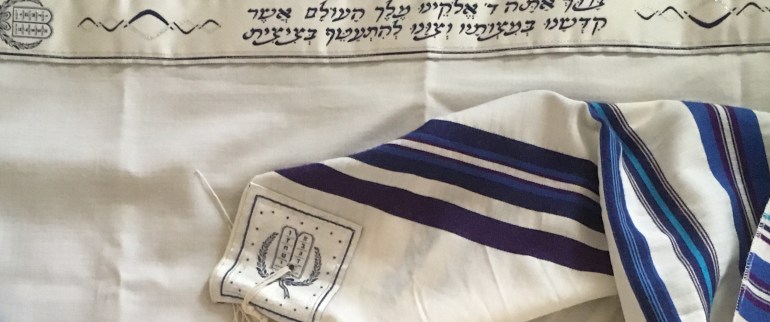
The experiment was that everyone would simply use the time for personal tefillah. All around me were people wrapped in tefillin, in tallit, in their own prayer. Sometimes mumbling. Sometimes singing. Flipping pages.

And me? As a latecomer and one with the barest novice-level familiarity with the liturgy, I found myself feeling alienated and discouraged at first. Lost, actually. I had a siddur in my hand but I didn’t know where to start. Would people hear me? Would people be able to notice I was wandering from Hebrew to translation to looking out the window at the incredibly beautiful trees? Would the flipping of my pages somehow give me away as the impostor I still am?

I wanted desperately for someone to show me what page I should be on.

But also — I realized how much Rabbi Harold Kushner’s teaching that, “Jews don’t pray for, Jews pray with,” means to me. While I was surrounded by people I like, I felt in no way connected to them. Each person in that room, though we share so much, was turned inward and upward for that hour. Each person prayed at his/her/their own pace and volume. I felt so alone. I wanted to pray with.

It was the perfect prayer experience for the smartphone age: everybody absorbed in a private experience, regardless of communal surrounding.

I forced my mind to think about prayer, about using this time in service of the Holy. What would it mean to be fully in charge of my relationship to the Divine? Aren’t I already? Why aren’t I already?

And what if my service to the Divine finds its fullest expression in relationship and in community? Perhaps I am missing the Divine in that theology. If, at any given moment, it’s all about the people in the room, am I truly engaging with G-d?

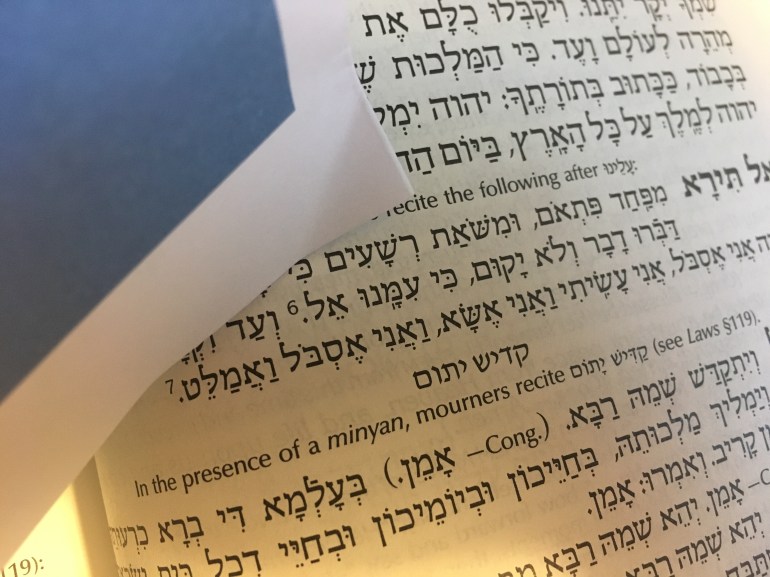
I opened up the siddur and found this.

Yehuda HaLevi from Sim Shalom

Is this the companionship I seek?

To be continued…

Tree of Life

The sea of words in response to yesterday’s barbaric shooting at Tree of Life synagogue in Pittsburgh hardly needs my contribution. As if the letter bombs and the grocery store murders weren’t appalling enough, this attack was the rotten cherry on top of a dreadful and violent week. We are heartbroken, we are reeling, we are searching for meaning and wondering where all this will end up.

Frankly I can’t deal with the big questions at the moment. I just have a few fragments of thoughts that are poking at me.

  • I’ve been thinking about the specificity of those who died, the people who showed up on time for shul. Karen Reiss Medwed* wrote about how every community has its on-time folks, the ones who arrive early and make sure the challah is where it’s supposed to be, greet guests, hand out siddurim and kippot. These are the behind-the-scenes people, the wonderful volunteers who care enough about showing up for others that they arrive early and stay late. Whatever is needed, they figure out a way to get the job done. In many ways they are the pillars of the community. And when the pillars are no longer with us, we must all stand a little taller to hold the community up. Every time we tuck the scrolls back into the Ark, we recite these words: It [the Torah] is a Tree of Life for those who hold it with strength, and all who support it are happy. I don’t know that we can find happiness just now in holding up the folks at Tree of Life, and by extension all who are hurting, but I do know we must do so.
  • I spent some time today on Boston Common, attending the Vigil in memory of those lost in the Tree of Life shooting. I’m not a natural at these big gatherings. I get claustrophobic, so I like to keep moving. This means I get to see who is there and observe how people are responding. It was moving to see people who were clearly of different religious traditions showing up for us. I hope and pray that we do the same for them, for as long as it takes, until we no longer need to make vigil after vigil for completely avoidable losses. May that day come speedily.
  • The vigil took place just feet away from “Lest We Forget,” Luigi Toscano’s installation of Holocaust portraits on the Common. Nothing more needs to be said about that. Just sit in silence with it for a minute.
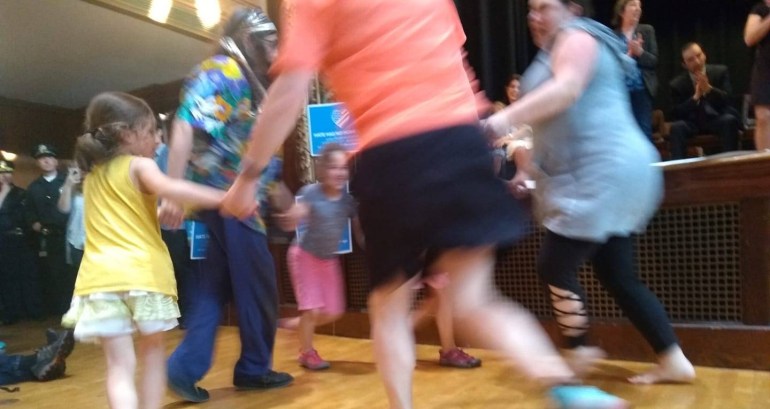
  • After the programmed part of the vigil ended, a moment of spontaneous singing erupted, like nothing I’ve ever experienced. It started with a small group of people singing, arms around each other and swaying in that Jewish way we can all picture. I didn’t recognize the song but I wanted to be in that moment. The circle quickly opened and grew, as more and more people were drawn in to participate. What started with a fistful of people ended up with probably close to 200. We just kept stepping back and opening our arms. We’ve been hearing a lot about how the shooter was upset about the congregation’s commitment to HIAS and to welcoming and assisting immigrants (as no doubt, many of them had been welcomed and assisted themselves). And we’d just been reading in yesterday’s Torah portion about Abraham’s model of hachnasat orchim (welcoming guests). The metaphor was alive and powerful. And then we sang Rebbe Nachman’s words about the world being a very narrow bridge and the essential thing being to have no fear at all. Bracing and beautiful.

I still have fear.

Screen Shot 2018-10-28 at 11.49.54 PM

in | between

For the first time in over a decade, we did not build our sukkah this year. Our sukkah parts are heavy and need to be put together by someone with height and strength. (I’ll pause while you snicker about my lack of both.) Most years, Bill has a day off work sometime between Yom Kippur and Sukkot and is able to do this. He doesn’t love it but he does it. This year, though, he had some extra work days at the store and you know the rest. Boys are uninterested in doing the work, so here we are.

In an O. Henry twist, for the first time in ages I have the luxury of time during Sukkot and no sukkah to sit in. My days are looser than they have been in a good long time, and while I have several projects that take up my attention, they are flexible to the time available and could totally be done while sitting in my sukkah in the golden autumn sunlight.

And yet in this time of in-between-ness, I scarcely need a reminder of impermanence. Where once I thought I would happily live out my remaining working days serving and building the community at Ohabei Shalom, that my work there would satisfy me indefinitely, those assumptions have crumbled, like the walls of an impermanent house. I am confident there will be another home for me, but what a rich and complicated gift to be in between at Sukkot.

You don’t get to go someplace new without leaving. At the moment I am far from the shore.

There is so much leaving and wandering in our tradition. Abraham leaves his father’s house and gives up his tradition in pursuit of what he knows to be true. Moses brings the people out of Egypt and forty years of wandering ensue. And the Torah ends with the end of the wandering. Or does it? The text actually gives us a cliffhanger: Moses cannot enter, leadership is transferred to Joshua, and then what? The topic returns to Moses. There is no mention of the people actually crossing over into the holy land. We are always becoming, always searching, always wrestling.

I am nowhere. I am now here.

Hineini. What’s next?

Belief & Sacrifice

Worshippers in many synagogues today read Akeidat Yitzchak (The Binding of Isaac). I have been puzzling over why this particular story is connected to Rosh Hashanah. It is so hard to read! I can’t imagine there is a parent anywhere who reads this passage and thinks, “Cool, I get it.” There could be no more painful commitment than the one that Abraham makes, to follow G-d’s instruction to sacrifice his beloved son. What, at this point, could he have had to prove? This is the Abraham who according to the midrash in Genesis Rabbah (38:13) smashed the idols in his father’s shop in order to help others understand the singularity and non-physicality of G-d, the Abraham who circumcised himself at age 99 (Genesis 17:24). This is not a man whose faith and commitment invite questioning.

Yet G-d asks the impossible of Abraham, to sacrifice his son, and he is prepared to deliver. The text rubs it in for Abraham: “Please take your son, your favored one, whom you love, Isaac, and go to the land of Moriah,” (Genesis 22:2) as if to make sure Abraham feels the full weight of what he is being asked to do.

Somehow Abraham is willing to take on this terrible task. And as Isaac starts to ask questions, Abraham keeps saying, essentially, it’s not ours to question. Let go and let G-d. Let’s go.

And the two walk on together, as one.

I keep asking myself what it would be like to have that kind of faith, to go forth with conviction that even the most incomprehensible, painful challenge is somehow going to turn out right, even useful. My brilliant teacher, Rabbi Marcia Prager, taught me that this story is a parable about walking in faith when the instructions are unclear.

In the end, Abraham and Isaac are saved, sort of. Just in the nick of time, an angel stays Abraham’s hand. Abraham sees a ram caught in the thicket. He releases Isaac and they offer up the ram instead. Afterward, G-d gives Abraham a blessing, that his descendants will be as numerous as the stars. His willingness to give up his son was enough to buy him a nation of descendants.

All’s well, right?

But notice! Abraham doesn’t go home. He stays instead in Beersheva. Perhaps he can’t face his wife. Perhaps he can’t face himself. Isaac disappears from the narrative for a while and for the remainder of his life struggles with trust. They are saved but they are changed. Although Abraham didn’t sacrifice his precious son, there was still a sacrifice that day.

I’ve been thinking about faith and sacrifice ever since the Colin Kaepernick ad dropped last week, the one whose tag line is: “Believe in something. Even if it means sacrificing everything.”
Screen Shot 2018-09-11 at 4.46.26 PM
I fully support Kaepernick’s right to protest and his method of doing so. With thoughtfulness and heart, he has brought our attention to some of the ways racism is still ruining our culture, more than 150 years after slavery ended in the US. (Slavery, I have come to realize, was not the disease, but a gruesome, near-fatal symptom.) His practice of kneeling for the national anthem before NFL games has sparked the national conversation about race that former President Bill Clinton aspired to all those years ago. It’s a conversation that’s not easy, but most worthwhile conversations are not. The level of anger that has been leveled at Kaepernick is shocking, a clear indication of barely veiled racism, and thus an indication of how necessary his work is in this moment.

Some people have taken issue with the protest, claiming that it denigrates both the American flag and US veterans. Respectfully, I disagree. Kaepernick’s protest has nothing to do with the flag, nor with the armed forces. It is a peaceful commentary on a problem in American society. Using his status as a public figure, Kaepernick has used non-violence to draw people’s attention to the horrific violence that is sometimes visited on unarmed black citizens at the hands of law enforcement. Despite suffering enormous professional and personal consequences, Kaepernick has stayed true to his principles, including that of non-violence.

Faith can make us do amazing things. It can inspire us to foolish greatness and it can spur us to great foolishness. The same zeal that moves people to make soup for the homeless and fight for immigrants’ rights also makes people fly airplanes into buildings. The confluence of Rosh Hashanah and that terrible anniversary should remind us that a deeply-held conviction is a double-edged sword. It’s great to be faithful, to be willing to go the distance. But Abraham learned that day that when you focus only on the sacrifice, you risk becoming blind to other choices, and when violence starts to look like a good solution, it’s wise to stay your hand and think twice. As Rabbi Sharon Brous said, paraphrasing Rabbi David Ellenson: always look for the ram in the thicket. The violent answer cannot be the final answer.

renew, return, recalibrate

Last night, Dena Weiss of Hadar gave a class at Harvard Hillel in preparation for the High Holidays. We took a look at Talmudic sources that could illuminate questions of how much atonement is the right amount, when it’s better to make apology and move on, what it means to see the same items on your cheshbon hanefesh (accounting of the soul) every year. ‘Tis the season.

Weiss made a compelling case for using these days of t’shuvah (return) with a gentle touch. Yes, we want to think about the things we have done and said that could have been better, more thoughtful, kinder, more patient, more compassionate. And yet we could also, Weiss argues, turn those desired qualities inward and give ourselves the compassion we strive to give to others. What would it be like to refrain from parading our picayune sins before our own eyes once they have been proportionally atoned?

We all have seen someone make such a show of apologizing that it starts to look like they’re a little in love with how it feels to apologize, perhaps even a little in love with the sin itself. This, Weiss argues, is not t’shuvah. It’s vanity. I would even suggest it’s virtue signaling.

For me, t’shuvah ought not be cumulative. If I say or do something unkind on Sukkot, I should apologize and make t’shuvah by Simchat Torah, maybe even by Sh’mini Atzeret. Like the missed dose of medicine that should be taken as soon as you realize you missed it, so too with a necessary apology. It’s when you save up all the missed doses until the Yamim Nora’im (Days of Awe) and wallow in the guilt of it all that you risk, frankly, overdosing on regret and self-recrimination in such a way as to blow the individual doses out of proportion. Maybe it’s cathartic, sure, but it risks veering toward being depressing or even performative.

The Midrash teaches that the first Yom Kippur arose spontaneously as a communal response to the shame and guilt of having built and attempted to worship the golden calf. Maybe the snarky comment you made to your sister-in-law that hurt her actual feelings was properly redeemed when you apologized with sincerity. Recalling it at Yom Kippur and apologizing again carries the risk of reopening a wound for both your sister-in-law and for you.

So if we take a pay-as-you-go approach to t’shuvah, what are these days for? If we apologize as soon as we realize we should, and do so honestly, what’s left for atoning? Is my cheshbon hanefesh actually clean if I just make it a point to do t’shuvah proportionally and within the statute of limitations?

Nope. Not so fast.

I would argue that the Days of Awe — and the month of Elul that precedes them — are when we are called to level up and look at the constellations rather than the stars. Those moments of making prompt apology — are there themes that keep coming up? Do they involve a topic that is troubling me more deeply than I’m willing to admit? Do they tend to involve one person? One type of person? Do they come about when I am in a particular state or situation? (Hangry? Moi?)

In a meditation class I took a zillion years ago, the teacher admonished that the finger pointing at the moon is not the moon. I’m still puzzled over that, but here it seems clear that the small- to medium-sized sins that are attended to (relatively) easily in the moment might be pointing to the bigger questions, those where cheshbon hanefesh takes on its real meaning.

Returning to the metaphor of the medicine, maybe Yom Kippur is our appointment to recalibrate our dosage. If we know we tend to be snarky to our children when they come into the kitchen asking for a snack while we’re making dinner (I’m just saying) of course we should continue apologizing every time we do the same damn thing and snap at them, but maybe we could also have a gentle word with them about patience and self-sufficiency…and make sure the fruit bowl is well-stocked.

If we know that we squander opportunities for genuine connection with others because we are embarrassed by thus-and-such or because we think we could never bridge the gap we perceive between us, it is time to recalibrate. If we know that there’s someone who has been on our minds for months but we’ve never quite found the moment to get back in touch, it is time to recalibrate. If we know there’s chesed we could be doing but aren’t, it is time to recalibrate.

And if we know that we continually deny our own dreams, bypassing a half hour of study or Hebrew practice in favor of making one more semi-clever comment (or a thousand) on Facebook, it is time to recalibrate.

Elul Writing: The Notes in my Pockets

PROMPT 12: The beloved R’ Simcha Bunim is perhaps most famous for using the pockets of his garments in order to embody the paradox of our existence.  As Buber recounts, Rebbe Simcha Bunim would teach:

Everyone must have two pockets, with a note in each pocket, so that they can reach into the one or the other, depending on the need. 

When feeling lowly and depressed, discouraged or disconsolate, one should reach into the right pocket, and, there, find the words: “For my sake was the world created.”

But when feeling high and mighty one should reach into the left pocket, and find the words: “I am but dust and ashes.”

What two truths do you need to hold in your pockets as you approach the new year? Perhaps they are in conflict with each other (e.g. you are happiest when you’re helping others and you need to practice saying no). What does it feel like in your body to move through the world carrying paradox with you?

This has been an unsettling week. In the past few days, I have received news about people I care about, news that is, frankly, shocking. Two people I am connected to are involved or suspected to be involved in serious wrongdoing, as perpetrators. I do not intend to write about the events themselves, at least not publicly, because in neither case is it my story to tell. I will say instead that these revelations have shaken me up and forced me to consider a new way to think about the truths in my pockets, the sometimes-conflicting core beliefs that guide my thoughts.

It rocks my foundations to think that people I know, or think I know, might have done terrible things. It is hard to absorb. At the same time I am praying that the accusations are untrue, I am wondering if they could be. I literally shudder to imagine it, and yet it is also hard to imagine that the accusation came from nothing. What kind of person does this kind of thing? What kind of person invents this kind of story? How can this be happening? It doesn’t add up.

If the accusations are true, what happens to the decades-long affection that I have felt for this person? Was I wrong to feel it? Are there sins that are unforgivable? If the accusations are untrue, is it a sin to give them consideration?

Near my home town, there are two billboards that have always caught my attention. They say, “Every saint has a past,” and, “Every sinner has a future.” Although the taxonomy of the phrasing is decidedly not Jewish, these signs contain a truth that is echoed in Jewish thought. They suggest that even the worst offenses do not tell the full story of a person. This is what I am clinging to as I wait for the truth to become clear, and they suggest one of the notes in my pockets:

All life is precious and t’shuvah is always possible.

The other note?

You never know what demons are inside a person.

To think and to do

PROMPT 10: What are you committed to thinking about in the coming weeks? Make a list. Forget the ‘to-do’s’, today we’re going to focus on the ‘to-consider’s’ (so much less intimidating!). When you’re done, ponder how you might turn deep thoughts into soul-liberating transformation.

Inspired by the aptly named Rav Kook, this prompt from Rabbi Jordan Braunig places value on the very act of thinking and ties it to the potential for transformation. I have had a lot of time to think these past two weeks, and it has, I must say, been blissful. (And with all the Aretha Franklin z’l video clips going around the internet since her death a few days ago, this prompt gives the clip from the Blues Brothers movie a little extra zing.)

So here are some things I might think about, considerations to consider.

  • Being a better partner to my husband: He has supported my every ambition and brings music, humor, and excellent cooking to our home on a regular basis. I think I will try to be nicer to him.
  • Being a better mother to our sons: They are pretty awesome. Sometimes I am grouchy. More often than you might think. I think I will try to be sweeter to them.
  • Calling my parents more frequently, but not so frequently as to get on their nerves.
  • Being more involved in the various communities in which I find myself: participating in chesed, volunteering to help organize things, being more of a leader.
  • Approaching my job search with a balance of passion and equanimity: passion in choosing what to try for, and equanimity in handling the inevitable rejection that is inherent in this process.
  • Keeping my heart open for insight and inspiration.

Blast

Another piece of writing inspired by Rabbi Jordan Braunig’s Elul writing prompts.

PROMPT 8: As we start this new week, I invite you to write that first blast of tekiah for yourself.  Journal about a moment of joy and completeness and success from this past year. Is there a moment this year that you can put your finger on where you experienced a sense of wholeness? Sing the song of that moment!

I spent the week after Tisha b’Av — the first of the seven weeks of consolation — at the Isabella Freedman Jewish Retreat Center in Connecticut. I was there to expand my learning about prayer leadership, through the DLTI (Davvenen Leadership Training Institute). This transformative week couldn’t have come at a better time. I arrived at the retreat badly in need of consolation, unsure of my future, afraid and alone. I knew that my job was ending. I knew that was the right thing. I had no idea what would be the next right thing, and that weighed on me.

I still don’t, by the way, but I feel much better.

Part of what helped was being at DLTI and having a safe environment in which to begin unpacking my conflicting ambitions, desires, hopes, dreams, fears, and practicalities. During that week, a purposeful prayer community developed. Though the people in our group came from many backgrounds and each had a different story and path, we shared a common purpose for the week: developing our skills in the leadership of prayer. We prayed together three times a day, studied the siddur, learned music both traditional and new, walked in the woods, talked, laughed, ate, stretched.

In the evenings, after the day’s planned curriculum concluded, a small group of us gathered in the lounge informally and sang late into the night. I called us the Shir Els, and nobody objected. There was some serious musical talent in the room, young people with guitars and songwriting credits and heart-stoppingly beautiful voices. First few days I barely opened my mouth.

But I grew.

downloadOn our last morning there, as we were waiting for a session to start, Joey Weisenberg’s Kol Haneshama was noodling around in my head. I started to sing. As I got into my groove, I caught the eye of someone across the room, who was singing too. We spurred each other on. A few more jumped in. The harmonies started to fill out — the two parts of the round intertwined like the strands of your grandmother’s challah. Rabbi Shawn Zevit found us on his guitar and kicked the groove even higher. Chairs became drums, the spaces between the seats somehow made room for the liveliest dancing this side of your wild cousin’s wedding. Clapping and dancing and singing. Pure joy.

That’s when I knew it was possible. That’s when I felt that whatever is unfolding will show me my path.

Elul Writing: If it’s broke, fix it yourself

Here’s another installment in the Jordan Braunig writing prompt extravaganza. It’s not too late for you to jump in, people!

PROMPT 5: Each of us comes to this with an element of brokenness, how can the arrival of this month allow us to imagine an ascent and a return to fullness?  What are the deep challenges that you face in shaping yourself this month?  What stone-carving-hard-work are you willing to do?

Ahhhh, the challenges I’m facing. Nothing too major, just trying to understand who I am. I wouldn’t worry about it if I were you.

My work for Elul (and beyond) is searching for a better sense of what I am meant to be. Over the past few months I have had the utter joy of encountering some people who are so exactly right in their own skin, it’s as if every molecule of them is lined up perfectly. They could not possibly be anything other than what they are.

I do not feel that way. I want to.

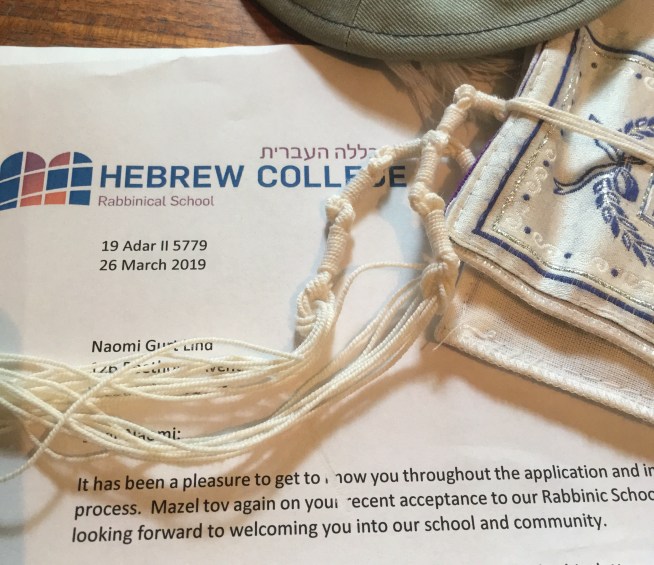
Lately I’ve come clean about my desire to deepen my Judaic study, an itch that’s been growing for several years now and that waxes and wanes but never seems to go away. Over the past several months I have been more public about this question, for better and worse. Now there is practically an army of people who have gotten on the “Naomi should be a Rabbi” bandwagon, which is lovely. I am often on that bandwagon myself. And yet, the stone-carving for me is, I think, to discern whether the bandwagon would exist if I were the only one on it. It’s great that my friends support me in the aspiration to become a Rabbi, and I couldn’t be more grateful for the encouragement.

But ultimately I’m the one who has to do the studying and make the sacrifices and find the money. I need to know that it’s a journey I take on for its own merits, a covenantal choice, rather than an ego-driven one.

I have doubts and certainties all at the same time. The stone-carving, soul-carving work is in waiting patiently to see when things come into focus and all the molecules line up.

Elul Writing: Spiritual To-Do List

Herewith another installment in response to Rabbi Jordan Braunig’s Elul writing prompts. If you’re not subscribed to this and you enjoy good writing — whether creating it or reading it — I highly recommend. Jordan’s introductions are at least half the fun!

PROMPT 3: Today, I invite you to spend an early moment in this month of self-growth and recreation, setting out a spiritual to-do list.  What concrete actions can you incorporate into these coming weeks that will help you feel anchored and prepared.  Perhaps you are aiming to experience silence every day.  Or, there are books and texts that you want to return to.  Maybe you want to wake up to the blast of the shofar.  While you’re at it, find space to take note of important conversations you want to have?  Give yourself a mix of easy and more arduous goals, so that you can feel the satisfaction of working your way through the list.

This instruction overlaps so neatly with the rest of my life, it’s almost tempting to just scan my to-do list in and call it a night. I am blessed at this moment with the opportunity to take a little time and space to discern what my next right step will be. Will I plunge back into the work world with a full-time, high-intensity job? Will I parlay the skills I’ve amassed in these past five years and enter the consulting arena? Will I pursue part-time work and test-drive rabbinic study?

I am eager to fill my days but not too soon, and not with just anything. I want magic!

While I scan the job listings and imagine what might be out there that fits me, I am spending time each day with the siddur. Along with polishing my resume, I am scheduling daily appointments to read about elements of worship I hadn’t considered. As I reconnect with my network, I’m also reconnecting with my tradition. And between coffees with colleagues, I’m preparing for a gig co-leading services on Kol Nidrei and Yom Kippur.

The to-do list is delicious: study the translations, learn the music, follow the bibliography trail, think, write, study, sing. I make a goal each day of words to explore, phrases to digest. One from Column A, one from Column B. Something in the siddur, something in Rabbi Hoffman’s book, a few phrases in the N’ilah liturgy. Back and forth and back and forth I go all day.

It is all too easy to think that this nice study smorgasbord is the Elul work. What’s essential, though, is to keep the spiritual frame on these daily habits I am trying to cultivate. There is a difference between studying the prayers and praying. Technical mastery is important, but there must also be room for holy mistakes. To allow for unstructured contact with the Divine, the contact that is at my current skill level, not my aspirational one, is part of the task.

Make holy mistakes. This is the to-do list on top of the to-do list.