There are no sidelines

In Jewish life, yesterday began the Three Weeks of contemplation and mourning leading up to Tisha b’Av, itself the saddest day of the Jewish calendar. Sometimes, it feels like the Jewish calendar and the secular calendar are out of harmony, but this year, the timing of the Three Weeks could not be more resonant. Indeed its resonance is sitting on my soul like a stone.

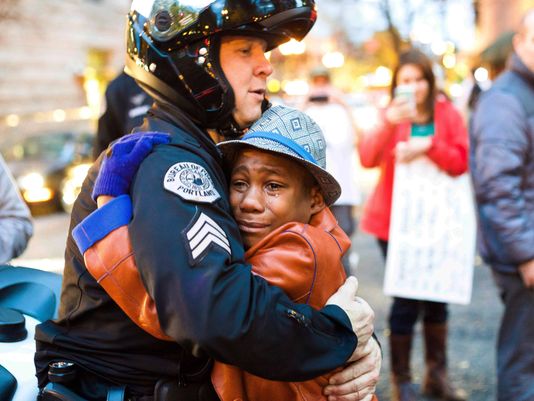
On Tisha b’Av, we fast throughout the day to commemorate the destruction by fire of the First and Second Temples. As black churches burn in the southern US — following a barbaric shotgun attack on another such church — the echo is clear. The hatred and fear that caused Jewish sacred spaces to be destroyed in ancient days is, sadly, still with us and now being directed at African-Americans.

I have always thought that there are strong parallels between Jewish and black experiences: the history of slavery, the strong cultural emphasis on education and artistic expression, the faith in G-d during troubled times.

Our tradition teaches us not to stand idly by while our neighbor bleeds (Leviticus 19:16). I’ve been struggling with how to live this out with respect to the black community. In the days immediately following the Charleston attack, I remembered how meaningful it was for my community several years ago to feel the solidarity of an interfaith gathering in the wake of anti-semitic vandalism. So it was an easy — if uncomfortable — decision to attend services at an African Methodist Episcopal church here in Boston that same weekend. Likewise, I was grateful for the opportunity to attend an interfaith vigil on the steps of City Hall in Newton in remembrance of the Charleston murder victims.

Someone asked me why I went, and what I hoped to accomplish. I have grown to place a high value on showing up. It’s not that my individual presence at either event mattered much, but being part of a larger group standing together in support made a statement. If each of us takes the commitment of showing up seriously, there will eventually be more of “us” than there are of “them.” And maybe — someday — there will be no “them,” because we’ll all of us realize there is no need of a “them.” Our humanity can bring us together, and being together can show us our humanity.

I’m glad to have been at those two events, but they were merely a start. There is much more we can show up for: rebuilding the churches in the south, guarding churches in the north, reaching out to leaders in the black community and asking them what they need. Most importantly, we must open up conversations with each other, bridge the gaps that allow fear and other-ness to fester. Although big conversations are needed in order to address the inequalities that continue to undermine our society, small ones are needed too. We must smile at babies and say hello to old men, sit down next to someone on the bus whose life we don’t see in the mirror and notice that they breathe the same air we do. We are all — every single one of us — created b’tzelem elohim, and we must allow that basic principle to be the ground we walk on. There are no sidelines, and this work awaits all of us.

Hinei ma tov

I woke up last Thursday with music and peace on my mind. Zamir was scheduled to sing at the Massachusetts State House in a joint appearance with the Jerusalem Youth Chorus, a multi-national, multi-faith, multi-lingual ensemble of teenagers from East and West Jerusalem who meet regularly to make music and make peace.

As I was packing my gig bag and getting ready to leave the house, I heard on the radio about the Charleston shootings, an act of barbarism that left me weak and teary. The idea that someone could be welcomed into a house of worship then murder members of the congregation hit me hard and continues to hurt my soul. It’s not unprecedented: it happened just months ago at Har Nof, when five Jews were killed while in prayer at their synagogue. This sort of attack violates basic decency and humanity, seemingly beyond repair; that it would happen twice in half a year makes me shudder.

My mood when I arrived at the State House, harried and rushed, was raw; but there is no greater mood elevator than music. Singing with my friends in that glorious place would have been enough — dayeinu! Seeing a fellow Zamirnik, a new mother, mouthing the words of Birkat Kohanim to her newborn son in the audience would have been enough — dayeinu! But then the JYC took the stage, and something magical, beyond even music, happened.

These kids sang a song they had composed together over the course of several months. The song was about what it was like to be them, and because the them in question is a variegated group, a mixed multitude, in one of the most contentious regions in the world, the song had a lot to say. Micah Hendler, the JYC’s founder and conductor, didn’t shy away from saying how difficult it was to work on the song together. What they were able to accomplish provided just the sort of hope I so desperately needed that day. The music was a rich stew of pop rhythms, Arabic chants, Hebrew folk sounds, and more; and the way the kids sang it, with full hearts and obvious, hard-won bonds, touched me deeply. When they ended the song holding hands, the place got misty, and it was clear that something profound was occurring.

After the applause died down, it was time for the two ensembles to sing together. One of the songs we did together was Akanamandla, the South African freedom song. The Zulu lyric had been supplemented with Arabic and Hebrew, saying, “We have the power, we have the spirit.” The message was clear: if South Africa can overcome its bloody history of apartheid and focus instead on making peace, so can other regions.

And on that day, it was painfully clear to me that the Middle East was not the only region in need of such healing. Our own country is struggling under the weight of a history it refuses as yet to face in a meaningful way, a struggle which grows more urgent with each tragic loss. But being together, singing together is a good first step.

We’ll still need to look for the next step — and take it together — but I suspect it will be quite a lot like the first step. The more we see each other, b’tzelem elohim, the better I like our chances.

A Blaze of Light in Every Word

Aside from the obligatory blintzes, two Shavuot traditions I treasure are studying Torah late into the night and hearing Megillat Ruth. I was fortunate enough to partake in both this year, and from them arose two thoughts that I’ve since been reflecting on. Since we often envision Torah as coming on two tablets at Sinai, and since Torah is considered to be an ongoing revelation and exploration, herewith my dosage of two tablets.

Tablet 1

For my late-night Torah, I typically go to a fabulous community-wide event in Brookline, which is co-sponsored by a wide array of congregations and other learning organizations. There are concurrent study sessions from 9pm till 4:30am on a dizzying variety of topics, punctuated at intervals by dinner, dessert, and a veritable Jordan River of coffee.

I’ve never managed to make it all night, but last night I stayed my longest yet — till nearly 1am. One memorable session I attended was entitled, “The Secret Chord that Pleased the Lord: Leonard Cohen’s Hallelujah,” in which we sang the famous song, then dissected it in chevruta groups. We jumped off by talking about some of the threads that run through the song: love, loss, searching, bitterness, and indescribable sweetness. To me, the strongest thread — almost too obvious to mention — is the word itself: Hallelujah.

Translated literally, it means, “Praise G-d.” This being Leonard Cohen, though, praising  G-d is not a simple matter. The lyric offers a smudged look at biblical figures, from Saul to David, to Batsheva, to Samson. We see them here as humans, as human as the rest of us: Saul the baffled king, David grappling with his faith and his longings. There is muted love and aching loss; nothing in this praise is triumphal or unencumbered. And when Cohen obliquely addresses his own relationship with G-d — “You say I took the name in vain / I don’t even know the name” — it’s with a sense of “whatever” capped by yet another Hallelujah.

In a commentary on the song, Cohen wrote: “This world is full of conflicts and full of things that cannot be reconciled, but there are moments when we can transcend the dualistic system and reconcile and embrace the whole mess, and that’s what I mean by Hallelujah.”

Legend has it that Cohen wrote eighty verses to this song. Whether they all follow a single narrative trail or whether they are tiles in a larger mosaic, each one culminates in a hard-won Hallelujah. Wherever we are, whatever we’ve been through, there is always praise. Praise is the ground upon which we walk, a ground which sometimes threatens to bury us but which ultimately holds us up. We may not know the name, we may not dare to understand the nature of G-d. Our praise doesn’t have to be fancy, for as Cohen teaches us, there is a blaze of light in every word, the holy and the broken Hallelujah.

Tablet 2

Like my children, I have the same name in English and in Hebrew. People often ask me the significance of my name, and in answering I have always focused on the literal meaning: sweet and pleasant. In fact, I’ve always been a little snide about it, as though there is no power in my Hebrew name, it’s just a namby-pamby sweetness and light kind of thing.

This morning’s reading of the Book of Ruth brought me a new perspective. Naomi, a major character in the story, starts with everything: a husband and two sons. And she loses everything: a husband and two sons. Everything she thought was true about her world came to nothing.

And that’s when she began to find out what she was made of.

After her losses, she journeyed back to her homeland with her loyal daughter-in-law Ruth. There she resourcefully found a way, despite her diminished status as a widow, to make a living and align herself and Ruth with her late husband’s relative, Boaz. And through Ruth’s marriage to Boaz, came the lineage of King David.

What looked like the end of the line — literally — turned out to be a corner for Naomi. And although she seemed to lose faith in the middle there, asking to be called Marah (bitter) instead of Naomi, she ultimately reclaimed her name, persevered, and lived to see the son of Boaz and Ruth, who himself would become the grandfather of the great King David.

This ancient history echoes a bit of ancient history of my own. Thank G-d my losses have not been as great as the biblical Naomi’s. Nonetheless, some years ago my family seemed to be under a dark cloud — illness, financial loss, and isolation embittered our days, and for a time it seemed as though we would never recover.

And then, gradually, and thanks both to loving companions and relentless striving, we did. The experience was arduous and deeply rewarding, teaching us along the way what is most important to us, and giving us the opportunity to experience true community and selflessness. It also inspired us to be more resourceful than we’d ever needed to be. I would not have chosen for those hard times to come to us — nobody would — but I am glad for all the learning and growth they afforded us.

I hadn’t seen the parallels between the original Naomi and myself until this morning when I received that bit of Torah on Shavuot.

There is a blaze of light in every word, and today I saw a glimpse of the one that belongs to me.

L’dor vador

L’dor vador nagid godlecha. From generation to generation, we will tell Your greatness.

This beautiful text from the Amidah reminds us of the duty, privilege, and joy of communicating our religious tradition to our children. It goes on to say: For all time we will proclaim Your holiness. Your praise, o G-d, will never depart from our lips. Blessed is HaShem, the holy G-d.

The texture and quality of this communication across generations is never far from my mind, either. I happily struggle with questions of how to transmit this tradition, of which my own knowledge is extravagantly incomplete. I happily struggle to provide my children with a deeper experience of Jewish tradition than I received as a child, in the age-old hope that their achievements might surpass my own. If in their learning and love for Judaism they feel an abiding sense of ownership and satisfaction, I will be glad. And if they view my life as an example of engaging in lifelong learning and exploration of Torah, I will be doubly glad.

This afternoon I had the honor of singing a solo in the beautiful Meir Finkelstein setting of L’dor vador, in a concert with the Zamir Chorale of Boston. Tickets to our concerts are normally out of my price range, especially to risk bringing squirmy kids who might not be able to stay through the end. Today’s concert, though, was at Hebrew Senior Life, a Jewish nursing home, and was a free event, and so I decided to ask Bill to bring the boys.

In preparation for my solo, I asked my 11-year-old son Akiva to translate the text for me. And in the concert, we sang it to a multi-generational group, many of whose members were visibly engaged in and moved by the performance. There were wistful smiles and a few tears, quickened movements and peaceful settling. The experience of sharing music across the generations is so much more than singing notes and words.

The experience, also, of telling G-d’s greatness across generations was there, and it flowed in both directions. In singing this piece in particular, I had the opportunity to share — and perhaps reawaken — a love of Jewish tradition and a connection to G-d, with an audience whose access to the beautiful world is limited by their circumstances and their infirmities. And in learning this song’s meaning from my beloved son, I received his youthful but no less ardent wisdom — and then received from him (and his sweet brother) the appreciation of hearing it sung and interpreted.

Adar (J)oy

We are in the middle of the Hebrew month of Adar, a month when we are commanded to be joyful. Commanded. It’s not a gentle suggestion or a request, it’s an obligation received from G-d.

Some years it’s easy: between Purim, the spring thaw, and the general goodness of life, the mitzvah of Adar joy is as simple as the sunlight outside the window.

This is not one of those years.

My various communities have been hit hard by tragedy recently. Since the beginning of Adar three weeks ago, I have attended four funerals and visited three houses of mourning. Two of the deceased were relatively young, and one of these young men was taken suddenly, leaving behind his wife and ten-year-old son.

I wander through my days, clinging to my children and my to-do list, barely listening to the chatter that surrounds, searching for some deeper connection that can carry me through the fog.

I find it where I always do: in community. Our custom of providing food for the bereaved is only the beginning. We have been watching each other’s children in order to enable each other to attend the mourners. We have been leading shiva minyanim and checking on each other more than usual and greeting each other with more kind looks and heartfelt hugs.

Adar may not be as joyful this year as in other years, but there is a muted joy in coping together.

Doorways

Most Jewish doorways are immediately recognizable as such by the mezuzzah posted on the side of the door frame, tilted so that it leans both in and out. We are commanded to mark our doorposts in this way, and even Jews who are estranged from their heritage often keep this mitzvah.

I’ve always loved the sight of mezuzzot: they are small, yet they can be works of exquisite beauty. They are more than just delicate, gorgeous boxes, though: their real power is inside, in the scroll that contains the Sh’ma, a simple declaration of the unity of G-d. Traditional Jews kiss their fingers to the mezuzzah upon passing through a doorway. I have always found that gesture deeply moving.

I’ve been musing lately about why we keep that reminder of our faith on doorways in particular — why not in the living-room or bedroom, where we are likely to hold our most important conversations? Or above the kitchen sink, where our eyes might turn as we prepare the food that sustains our families, where Shabbat dinner takes shape each week?

What is it about doorways?

I guess each doorway, each change, makes us want to check in with G-d. A doorway can be a passageway that changes us — we come in (excited and scared) to new situations, we depart (in resignation or in hope) from situations that no longer work for us. Sometimes we find our way to new places we didn’t even know we were seeking. As we pass through doorways both literal and figurative, we make a habit of remembering G-d with love, of remembering where we came from and what matters to us the most.

From my childhood Torah, the Rodgers & Hammerstein oeuvre, I learned that, “When G-d closes a door, He opens a window.” And when Jew passes through a door, G-d provides an opportunity to reflect on that moment of passage. Responding with love seems exactly the right thing to do.

I’m ready to play today

About a decade ago, I made a wish: that someday my Judaism would be at the center of my life, rather than being something extra. At that time, I was a semi-regular participant in weekly prayer and Torah study and had taken a few classes – but I was still unsure of my derech, and felt a deep sense of imposture and inferiority.

I thought I knew what “really Jewish” looked like, and when I looked at myself in the mirror, I didn’t see it. I didn’t keep Shabbat, didn’t know much about the dietary laws, didn’t have a community around me. I didn’t engage in Jewish conversations of any consequence and didn’t have an idea about the future of Jewish life and what role I might play in it. I was curious but uninformed, interested but unengaged. But also: I thought that Jewish authenticity wore a white blouse and a long skirt, lit candles at the right time each week, and walked to shul with family sweetly in tow. Real Jews didn’t drive to shul (and still arrive late!) or argue on the way home over who gets the first turn with the iPad.

It never occurred to me that the center of my life would be strong enough to hold a Judaism that speaks directly to me. And yet – I work in a Jewish agency, sing in a Jewish choir, send my children to Jewish school and camp, and host or attend Shabbat dinner just about every week. My volunteering hours are taken up with supporting Jewish organizations, and most of my friends are Jewish.

Maybe I needed a different mirror.

I continue to define and refine my sense of what it means to be Jewish. This definition sometimes goes through several phases in one day. Is it about halacha? Is it about ethics? Is it about studying Torah? Prayer? Community engagement? Israel? If we hold by the traditional belief that every earnest thought about Torah, past and future, was given at Sinai, does that include all my thoughts about Jewish pluralism and the pathway forward for Jewish community life in the 21st century?

I hope so.

I now see that my Judaism is at the center of my life. My Judaism. It might not fit any prescribed notion of authentic Judaism, but as Jewish identity and community fill more and more corners of my world, I feel more and more like my tradition finally belongs to me.

Begin the Beginning

This time of year has many overlapping beginnings — new school year, new Jewish year — to which I’ve added, this year, new job and new congregation. As the fall chaggim come to a close, we turn again to the beginning, scrolling back to B’reishit.

In the past year, I’d discovered the irony of working at a synagogue. While I was closer to synagogue life than I’d been in recent years, my purpose there was to facilitate others’ spiritual work. Meanwhile, my own spiritual life was feeling more and more distant. Sort of like the cobbler’s children having no shoes.

Now that I am working for a Jewish communal organization, I no longer work nights, weekends, and holidays: I can be Jewish again! In the past weeks, I have enjoyed simple pleasures like hosting Shabbat dinner in my sukkah and dancing with the Torah scrolls again. I have had the honor of dressing the scrolls and have been invited for several festive meals with friends.

Having had three late nights in a row with the boys, I hadn’t expected to get to services today, although I dearly love starting again at the Beginning. I was thrilled when my friend called to invite them to come to a movie this morning, freeing me up to go to shul alone. It was a beautiful, contemplative service and having a little breathing space around me showed me the metaphor in the 2nd creation story for the first time.

Call me slow.

I finally see that the Garden is like infancy — and that the discovery of the tree, the temptation, and the curse are all part of life. It’s not a terrible fall from grace to discover that there are choices in life, and the choices we make matter, and that people sometimes blame others when things go wrong. This Torah of ours is not trying to shame us into an eternal guilt trip, it’s showing us who we are. Adam and Eve aren’t punished for doing evil; their curiosity was not a sin, and G-d’s response is not a curse.

It’s a statement of fact: snakes are gross, childbirth hurts, and farming is hard.

G-d drives the two out of the Garden, sending them into the world, and stations cherubim east of Eden, guarding the way to the Tree of Life. Those of us who encounter these angels and discover the Torah, Eitz Chaim, are brought back to Eden when we study, and are given the chance to learn for ourselves. And each year, when we return to the Beginning, we have the opportunity to see it anew and to try again.

Our hope is not yet lost

I arrived half an hour early and traffic was already being directed to the outer outer parking lot.

When I approached the building, I had to show ID. When I entered, my bag was searched while I passed through a metal detector.

It wasn’t international travel that necessitated these precautions, it was attendance at the memorial service for Naftali Fraenkel (z’l), Gilad Sha’ar (z’l), and Eyal Yifrach (z’l), the three Israeli teenagers who were murdered a few weeks ago.

The boys – our boys, as they came to be known – died not with guns in their hands but making their way home from yeshiva.

Truth to tell, I was a little wary of going to this service. I had the queasy feeling that it might turn into a political rally, and I didn’t feel ready to do more than grieve. I have been carrying this event around in my heart – as I watch my younger son grow and dance and laugh and sing and dress up as Dumbledore, as I watch the mailbox for a letter from my elder son at sleepaway camp – and have not been able to process the tangle of emotions it evokes in me.

And there was, in fact, more speechifying than I would have planned, if I were queen of the world. Yet the point of the speechifying ultimately was demonstrated by the security precautions surrounding the event. It’s not the usual thing for a memorial service to have a metal detector phase. While the saying goes that there is safety in numbers, it is not always true. I had the unfortunate flash this afternoon when I learned doors were opening for the service an hour early: a wide swath of the Boston Jewish community will be in attendance; it would be a tempting target.

Although I wanted the event to be personal, I now realize it could not have avoided being political. What happened to the three boys was political. It was not a random act. And every day – including the day of their funerals – Hamas (which in Hebrew means destruction) fires rockets into the state of Israel. Every day.

There was not – there is not – safety in numbers, but there is solace in numbers. When people join together in solidarity, when we grieve together, when we pledge to stand tall against slander and murder, there is hard-earned solace.

And when we sang Hatikva at the end of the night, with the poignant words, “lihiyot am chofshi b’artzeinu,” I dared to hope that we might one day be a free nation in our land, and be able to attend memorials for old men and not have to stride through metal detectors to do so.

Passing/Strangers

Assimilation has been on my mind lately. Both Purim and Passover deal in this question. Each story has as its central figure a Jew who passed between worlds, sometimes emphasizing Jewishness, sometimes hiding it. In the Purim story, Esther passed in a non-Jewish world until the situation demanded her to reveal the truth about herself. Similarly, Moses, having been adopted by the Egyptian princess but raised Jewish by his own mother/nurse, grew up as Egyptian but knew he was a Jew. He stayed in this in-between space until he could no longer: when he saw the cruelty inflicted on his people by his almost-people, he lashed out, killed an Egyptian, and fled. It was nothing less than the voice of the Holy One that compelled Moses to return to Egypt and free his people.

I find it interesting that both these stories deal with the in-between space of being Jewish in a non-Jewish world. I find myself often to be in this in-between space, frequently questioning whether I will ever feel wholly Jewish, even given how much I have changed about my life in these past years in order to more fully align myself with my Jewishness.

By virtue of having a pluralistic community around me, I have learned that there are many ways to be Jewish. The whole notion of Jewish identity is itself multi-faceted. In my own community, we have a dizzying variety of observance and belief, all of it informed by a desire to live a life of kindness and usefulness.

I look constantly for ways to have Judaism be at the center of what I do, rather than an ancillary aspect of my being that I squeeze in. It turns out to be a moving target. By virtue of working at a synagogue, I find myself torn between observing holidays and facilitating others’ observances. Being in a family comprising a variety of needs and temperaments, I cannot always (or even often) prioritize my own spiritual needs. Living in 21st century America, I constantly negotiate among a variety of identities: mother, wife, friend, professional, singer, Jew – and more.

I think there is beauty and richness in this tension of being in between, and sometimes it arises in unexpected places. I spent the first part of Passover in Mississippi with my family. Then we came home Wednesday evening, in time for Bill and me to return to work Thursday. By coincidence, I was invited to sub in at my old church job for Holy Thursday. I worked all day, picked up the kids from their respective play dates, came home to make a spinach matzo pie, and then went to Cantor a Mass. Of course.

The Vicar of this parish is a lovely guy, a real mensch. As he is a member of the interfaith clergy association that meets at my new place of employment, I am guaranteed of seeing him once a month, which I love. He is unfailingly kind and cheerful, and brings a refreshing humility to every encounter. I was deeply touched when he began Thursday’s Mass by saying to the congregation how pleased he was to welcome me back for Holy Thursday, a service which locates itself at an intersection between our two traditions. From the pulpit, he wished me a happy Passover and said how honored the parish was to have “an older sister in the faith” lead the music that night. I didn’t feel at home, but I did feel like a welcome guest.

I think of these questions of identity and fitting in – when to be this, when to be that – as a modern problem. But even my ill-educated glance at the ancient texts shows that Esther and Moses encountered it as well. As one of my Rabbi friends frequently says, “If it weren’t a problem, they wouldn’t have written about it.” We read in the Haggadah, “My father was a wandering Aramean.”

And so are we all.