M’kadesh haShabbat, Part 1

Shavua_tov.waving-e1561305225489I recently had the privilege of attending a four-day training in Mexico City for leaders in the Limmud movement. In brief, Limmud is an international community of volunteers who create events — by Limmudniks, for Limmudniks — around Jewish learning and culture. The training was a wonderful eye-opener for me, helping me to understand more deeply the Limmud values held by every Limmud around the world, and how those values can and should inform every Limmud activity. Having recently assumed the role of Chair of LimmudBoston, I was excited and honored to participate.

The training brought together leaders from Limmuds throughout North, Central, and South America — from the fledgling team just starting up in Sao Paolo to the huge and well-established Limmud Atlanta + SouthEast. We were a multinational, multi-lingual, multi-denominational, intergenerational cohort, engaged in a shared project of deepening our skills and perspectives in order to support one another and strengthen our individual organizations.

Little did I know that my time at the training would intertwine my vocational direction with my LimmudBoston work! As the training took place from Thursday to Sunday, our deliciously diverse group spent Shabbat together as a community. Several months before we gathered in Mexico City, participants had been offered the opportunity to volunteer to lead services, and to indicate which type of services we would be most comfortable leading. Five volunteers had checked the box for leadership, myself included, encompassing several different denominations and styles of worship. Of course, when there are variegated religious practices, this can make Shabbat complicated. As a people, we Jews have an astonishing range of prayer possibilities — from arranging seating by gender (or not), to determining whether to pray in Hebrew or in the vernacular, to deciding how much singing to incorporate and which tunes.

In true Limmud fashion, there was no decree from on high as to how we would organize our services. Naturally we decided to approach it in a Limmud-y way, that is, with guidance from the Limmud values which we had been studying in the training. Thursday afternoon it was announced that these five people would be leading Reform, Conservative, and Orthodox services for Shabbat — and we were left to our own devices to figure out what that meant.

At first I panicked! I was tired and scared and felt unprepared to step into leadership in this way. I like having a few weeks’ notice before I lead services. I like to have time to plan, to write kavannot (interstitial readings designed to deepen the experience), to choose the parts I’ll do aloud and practice the parts whose words I stumble over. My first instinct was simply to step aside and let others take care of it.

[Un]fortunately, once my name was announced as one of the leaders of the Reform service, people started coming up to me and saying how much they were looking forward to services. So I couldn’t back out; people were counting on me. At the same time, all together we were a group of only about fifty people, and having three or four separate services would end up making for several small groups. Likely some groups might not be able to make a minyan. Plus it just didn’t feel right. Surely we didn’t invest ourselves into the Limmud way of life, only to opt for dividing ourselves along lines of religious practice when gathered in the service of building community.

Reaching into the learning we’d already begun to do together, the discussions about Limmud values began. The Limmud movement embraces Religious Diversity as a core value. What if we pooled our leadership resources and did one service together, so that we could bring in Shabbat as a cohort? This would mean navigating many issues but we decided to do it together, as an exercise in another Limmud value: Argument for the Sake of Heaven (machloket l’shem shamayim). Embracing an ethos of Respect (another Limmud value) and care for one another (i.e. the Limmud value of Community and Mutual Responsibility), we sat down together and began to figure it out.

Some of the questions that came up were: what liturgy to include, who should lead, how we would arrange the seating, and who counted for a minyan. Each of these considerations can be fraught with resentment and disdain if not navigated gently. Orthodox tradition requires that certain prayers are led only by men, and typically holds that only men count for a minyan. Meanwhile, four of the five volunteer worship leaders were female. The discussion could easily have devolved into sniping, but informed by our learning, the opposite was true. The Orthodox participants looked for every possible way to be inclusive that did not violate the halacha (Jewish law) that informs their practice. Meanwhile the non-Orthodox participants sought to be fully involved without undermining the religious experience of our new friends. It made for a wonderfully collegial process, which opened all our minds and hearts more than I think any of us anticipated.

***

“My community usually uses a mechitzah (a physical separation between men and women, often a makeshift wall).”

“Many women in my community are offended by the presence of a mechitzah and won’t come if there is one.”

“Where would we get a wall anyway, on three hours’ notice, in a hotel in the middle of Mexico City…”

“Have you ever heard of a tri-chitzah? It’s three sections: one for women, one for men, and one for people to sit together as they choose. How would it feel to you to have it that way: women — mixed — men?”

“To tell you the truth, I’m a little uncomfortable with that. Is there anything else we can try?”

“But remember, many Jews who approach worship less traditionally will be uncomfortable if they can’t sit with whoever they want.”

“And if there is someone in our group who doesn’t identify with the gender binary, we want them to feel included.”

“Can I gently point out: I’m uncomfortable not being counted for a minyan (a group of ten adult Jews praying together; in some communities only adult Jewish males count toward a minyan). It might just be that we’ll all have to be a little uncomfortable.”

“That’s a good point; I never thought of it that way. That makes a lot of sense. I can live with the three sections.”

“Does it feel better to you to have the mixed section in the middle or one side?”

“I’m OK either way, thanks for asking.”

***

We decided on some basics: the women would lead Kabbalat Shabbat up to and including L’cha Dodi. As this part of the service is mainly a group of psalms chanted in preparation for Shabbat, it did not require male leadership in a traditionally-observant context. We would arrange the seats in three sections, so that those who prefer to separate by gender could do so, and those who prefer to mix — or who don’t identify with a gender binary — could sit in a mixed group. After Kabbalat Shabbat, we would take a short break for lighting Shabbat candles, then return to the prayer space for Maariv, led by the one man who volunteered to lead worship.

***

“We plan to make Kabbalat Shabbat more creative and experimental.”

“Great! But to me, it doesn’t feel like Shabbat if I don’t pray Yedid Nefesh and L’cha Dodi in their entirety.”

“Funny, in my shul we only do the first verse of Yedid Nefesh.”

“Really? I have been to some places where they only do the last verse, but they do it several times.”

“I’ve never heard of that, how does it go?”

[…a couple of lines of the Shir Yaakov tune…]

“Ohhhhhhhhh, wow, that’s beautiful!”

“We can do the whole thing, though, no problem. Do you have a favorite tune?”

“Whatever you do is good. Thank you.”

***

With the basic shape defined, the three other women and I sat down late Friday afternoon to plan our portion of the service. We hoped to create a spiritual atmosphere with joyous singing and soulful readings. In deference to the many languages spoken in our group, we decided to include a Brazilian pop song adapted for Shabbat, a reading in Spanish, and a reading in English. I asked for the privilege of beginning the service with a welcome and a kavannah.

***

“I only really know the first verse of Yedid Nefesh because that’s what my shul does…”

“If we choose a good tune, people will join in.”

“Should we do the feminine version or the masculine one?” (Yedid Nefesh is, in oversimplification, a love poem to G-d. In some siddurim (prayer books) the G-d language is feminine and in some siddurim the G-d language is masculine.

“Let’s let people choose as they wish. People are going to sing it the way they know it. It’s a perfect metaphor for what we’re doing!”

“OK. Here’s the Brazilian song we want to teach.”

[…the room rocks out…]

“Amazing.”

download

“OK, what about the tune for L’cha dodi?”

“I love Joey Weisenberg’s tune!”

[…we sing a few verses…]

“That is gorgeous but we really want people to sing along and I think Joey is mostly a North American phenomenon.”

“On a broader level…do we want to be teaching tunes, or just praying? [remembering the Brazilian pop song] How many tunes do we think we can teach before it becomes more like a learning session?”

“Sigh, but I love Joey…” [guess who!]

[…we try a bunch of tunes, nothing clicks until one does, the fast one in freygish mode…]

“Ooooh, maybe people will dance!” [again, guess who!]

“No way, not in this mixed group. Let’s not push our luck!”

“OK. [sigh] I love Rabbi Rachel Barenblat’s translation of Ana b’Koach; I’d like to read it for the English selection.”

[…I read it…]

“That’s amazing but isn’t it later in the liturgy?”

“Good point, maybe I could adapt it a little and leave out the last line. The poem is so great, and it makes a good ending for our service.”

“I really like the reading from the Reform siddur, the one that begins: I begin with a prayer of gratitude for all that is holy in my life. Can we include it?”

“Ooh, beautiful! Let’s translate it into Spanish and have it for our Spanish reading!”

***

We finished our planning ten minutes before we were to begin services, and quickly went to our separate rooms to change clothes and get ready. We came back down and took our places in the conference room, now transformed into a tri-chitzah prayer space, chairs facing east. We started a niggun (a wordless tune) and invited people to enter the space, gently identifying the sections for those who weren’t sure where to sit.

The niggun rose and quickened, then settled in. I stood up to begin.

To be continued

Click here for the next installment.

We will outlive them.

Yesterday I sang in a concert, one of the last communal events at Temple B’nei Israel in Revere. The congregation had fallen on hard times and made the gut-wrenching decision to close its doors. In recognition of this transition, my friend Jake Harris, who is the Cantorial Soloist there, created a beautiful, heartfelt concert that acknowledged the ending and the loss but was resolutely optimistic. In his remarks between songs, he spoke of taking what people had learned and experienced in that community and bringing it forth as a light for the world. We sang of making ourselves the sanctuary for G-d’s presence to dwell in.

I notice that no matter how hard the circumstances, we Jews can’t help schmoozing. (I want the t-shirt, “Can’t Help Schmoozing” – who’s in?) Even at a protest vigil last Tisha b’Av, we were engaged in connecting with one another. Mind you, Tisha b’Av is the saddest day of the Jewish year, a day on which we are forbidden even to greet one another. And last year its sadness was compounded by the reason for our protest: the deplorable practice of family separation at the border. Still we gathered, we prayed, we sang… and we schmoozed.

There is something in the Jewish soul that, despite everything, gravitates toward joy and connection. Our history might well have defeated our spirits, and yet the opposite seems to happen, over and over.

We are not the only people of resilience, nor the only people who have suffered brutality and persecution. But damn we know how to rise from the ashes.

After the concert for the synagogue that closed, I raced to my friend’s house to lead a Torah study. One text that we learned was this famous line from Song of the Sea:

עָזִּ֤י וְזִמְרָת֙ יָ֔הּ וַֽיְהִי־לִ֖י לִֽישׁוּעָ֑ה

(G-d is my strength and my song; and will be my salvation.)

As we studied, we explored the question of what we need, what we hold tight to, in anticipating salvation. The salvation is clearly in future tense here, so I asked my group: is it strength and song that tide us over until our deepest hope is realized, or something different? Is the line showing correlation or causation? If we could write the recipe for ourselves of what we need to hold us steady until that day, what would be in it?

For me, the ingredients in that recipe would probably be community, community, and community. And when the community is together in song and celebration, I feel ten feet tall and bulletproof.

We are living in serious times, and we need a lot of that feeling. I think I’m noticing that, in fact, we have a lot of that feeling, that despite everything we’ve been through and the collective sense of trauma and dread that many of us are experiencing, we power through and refuse to be defeated.

Tonight I attended a solidarity gathering in support of two local Chabad communities that experienced suspicious fires in the past week. With all that the community has absorbed in these past six months, from Pittsburgh to Poway, from vandalism to arson, from desecration to propaganda, nobody would begrudge us a somber mood. Yet the tone ranged from resolute to joyful, complete with singing and dancing.

There is a Yiddish song, Mir veln zey iberlebn, iberlebn, iberlebn – We will outlive them, that has an origin story worth repeating. In 1939, a group of Hassidim were backed into a corner by Nazis and ordered to sing to their own execution. One man started, at first, Lomir sich iberbetn, iberbetn, iberbetn? – Why can’t we get along? Nobody joined in.

Then he improvised, Mir veln zey iberlebn, iberlebn, iberlebn – We will outlive them, and the Jews began singing and dancing in a wild frenzy. That spirit, the one that dances in the face of annihilation, that cleans up and buries its dead after an attack and keeps going will hold us, together, as it always has done.

As Rebbe Nachman of Bratslav wrote:

כָּל הָעוֹלָם כֻּלוֹ גֶשֶׁר צַר מְּאֹד וְהָעִיקָר לֹא לְפַחֵד כְּלַל

The entire world is a very narrow bridge; the most important thing is not to be afraid.

Origin Story

HCFund bookshelfLike many great ideas, this began as a crazy idea. I was on a Jewish unity mission, a trip that took our group to houses of worship and places of learning all across the Jewish continuum. So it was that in a small, soulful weekday shacharit, in an Orthodox minyan conducted almost entirely in Hebrew, I was overcome with emotion at the beauty and depth of the worship and heard myself say, “I want to go to Rabbinical School.”

I tucked that away for years, because it made no practical sense. I didn’t speak Hebrew, I didn’t know very much about Jewish tradition, I was (ahem) older than the usual graduate student and not religious, whatever that means. Yet the thought kept poking at me. By that time, I was writing about Jewish text, deeply engaged in the lives of multiple communities, leading worship. And the more holy encounters I had, the more I began to feel like a Rabbi, or at least, like a potential Rabbi.

Perhaps there was something there.

When it became apparent last year that an employment change was necessary and imminent, I decided to use my newfound free time to take the dream seriously. I audited two classes at Hebrew College in the fall and began studying Hebrew with a vengeance. I loved it, all of it, even the confusion and feelings of inadequacy! I was standing at the bottom of an enormous mountain and it was thrilling. It felt like my mountain.

So I applied to Rabbinical School.

And I got in.

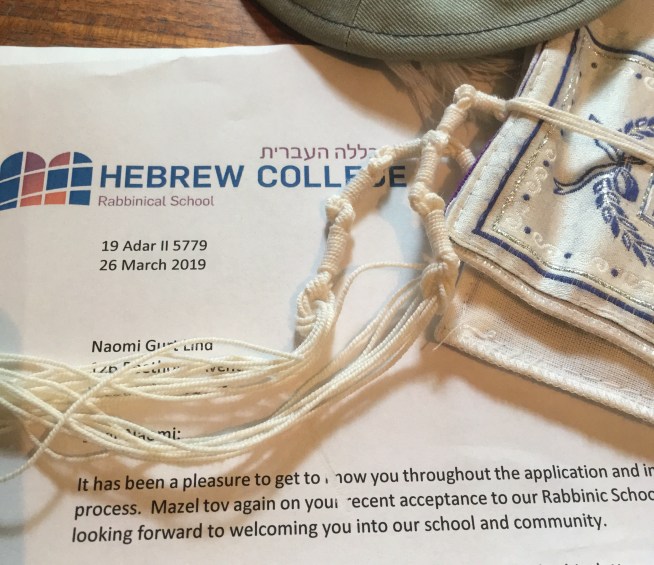
HCFund acceptance letter

And I got a merit fellowship, which — while it doesn’t cover all my tuition — brings my dream into the realm of the possible.

Last week, with my heart in my throat, I signed on the dotted line and accepted my place in the incoming Rabbinical Ordination class at Hebrew College.

***

HCFund - infamous facebook postSince I “went public” about this dream, I have been boosted up more times than I can count by the encouragement of family, friends, neighbors and colleagues. I expect I’ll need more of the same in the coming years as I learn Torah and Talmud and ritual and Hebrew and Aramaic and other things I don’t even know to name yet. It will take time, hard work, and the support of my community.

HCFund Hebrew books & flash cardsIt will also take money. Even with a fellowship, I will have a $15,000 gap per year in the first three years, to cover the remainder of the tuition, language tutoring, books, and the like. I am in the process of looking for part-time work and a High Holiday soloist job.

I have always felt that a community can accomplish so much more together than any individual can alone. If your resources allow and if your heart moves you in this direction, I am earnestly asking for your support. You can make a contribution directly to my PayPal (consider $180 or whatever you can afford). And if you’d like to follow along on the journey, click here to sign up for my monthly emails (a little update, a little Torah, a little humor).

NGL w hummingbird croppedI am excited to think of the work that I can do as a Rabbi. Whether I lead an established community, start one of my own, or expand upon the engagement work that has filled my last several years with joy and meaning, I am confident I can make a positive difference for the Jewish community and I look forward to serving. My family and I are grateful for any support you can offer, including having read this message. (Feel free to share it with others who might be interested.)  Shalom and todah rabbah!

Some Thoughts on Haftarat Mishpatim

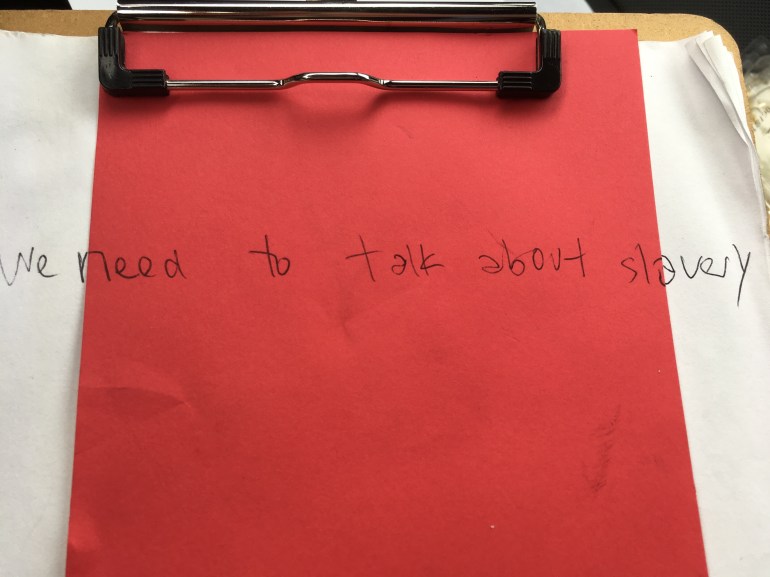
We need to talk about slavery. As American society seems to be going up in flames around us, we need — we absolutely need — to open our hearts and our mouths and begin to talk about the legacy of slavery, a legacy which sometimes feels as if it will never be resolved.

Haftarat Mishpatim gives us a framework — albeit a troubling one — to start the conversation. We read that B’nai Yisrael held slaves, even Hebrew slaves. We know this because the scripture tells us the rules about how to treat Hebrew slaves. (Hint: it’s a hair’s-breadth above how to treat other slaves, and it’s still no good.) In Mishpatim we are reminded that our ancestors were obligated by divine covenant to release all Hebrew slaves after six years of servitude. Which means G-d knew this was happening and didn’t put a stop to it.

The premise of this covenant regarding Hebrew slaves is bothering me, as a Jew and as a human being. How is it that our ancestors — of all people — could not see and acknowledge the harm of slavery? Having been enslaved ourselves and having redemption from slavery as one of our foundational stories, it is the height of arrogance and inhumanity to accept slavery as a practice. We are constantly being reminded in our sacred texts to take care of the stranger for we were strangers in the land of Egypt. How is it that our sacred texts do not also teach that slavery — the depths of our people’s degradation when we were in Egypt — is wicked, unredeemable?

It’s like a reverse dayeinu: it’s bad enough that we did not condemn slavery. It’s worse that we held slaves ourselves. And it’s still worse that we enslaved our Hebrew brothers and sisters.

But did we? This bothered Rashi, too. Rashi suggested that perhaps the proof text (Exodus 21:2) meant to refer to acquiring a servant from a Hebrew, rather than one who is him- or herself a Hebrew. Or that it meant you had acquired a Hebrew servant by means of redeeming him or her or them from destitution.

Cold comfort. We are still talking calmly about the prospect of one human being claiming ownership over another. We are taught above all else to love our neighbor; holding slaves does not fit with that. Gratefully, present-day Jewish authorities have caught up and we no longer accept slavery as an acceptable institution.

Still, I hold that we need to talk about slavery.

Americans need to talk about slavery.

Perhaps you are thinking that slavery ended in the US on New Year’s Day in 1863, with President Lincoln’s Emancipation Proclamation. Actually the Emancipation Proclamation was incomplete, only freeing slaves in ten Confederate states. The thirteenth amendment, enacted on December 6, 1865 after more than a year working its way through both houses of Congress, provided a more thorough coverage, in that it declared slavery and involuntary servitude illegal throughout the United States, except as punishment for a crime.

It’s that loophole that bothers me, for following on the heels of the Civil War’s end, laws began to be passed that effectively separated and oppressed the newly freed slaves. African-Americans, on whose backs the country was built, were systematically discriminated against in where they could live, learn, eat, even where they could take a drink of water. Although the slaves were freed, these laws, known collectively as Jim Crow laws, kept whites and African-Americans separate. The lives of the former slaves were made hard through legislation rather than through slavery. Segregation was a subtler — barely subtler — way of keeping African-Americans socially and economically enslaved. The law picked up where the whip left off.

It took about a century to dismantle the Jim Crow laws, but the criminalization of black skin continues still. From drug laws that disproportionately target minority populations to police brutality to the school-to-prison pipeline, we are still suffering as a society from the ripple effect that began with slavery.

So we need — we still need — to talk about slavery. We need to talk about slavery in America, and I would argue that American Jews are uniquely positioned to open the conversation.

Jeremiah 34:15 describes how B’nai Yisrael at first did the right thing, releasing the Hebrew slaves. But then in pasuk 16, we read:

וַתָּשֻׁ֙בוּ֙ וַתְּחַלְּל֣וּ אֶת־שְׁמִ֔י וַתָּשִׁ֗בוּ אִ֤ישׁ אֶת־עַבְדּוֹ֙ וְאִ֣ישׁ אֶת־שִׁפְחָת֔וֹ אֲשֶׁר־שִׁלַּחְתֶּ֥ם חָפְשִׁ֖ים לְנַפְשָׁ֑ם וַתִּכְבְּשׁ֣וּ אֹתָ֔ם לִֽהְי֣וֹת לָכֶ֔ם לַעֲבָדִ֖ים וְלִשְׁפָחֽוֹת׃

But now you have turned back and have profaned my name. Each of you has brought back the men and women whom you had given their freedom, and forced them to be your slaves again.

The consequences Jeremiah predicts for doing so are fearsome: G-d promises violence, disease, and famine; and pledges to make those who break the covenant a horror to all the kingdoms of the earth. The word of G-d as it came to Jeremiah is beginning to make a critique of slavery and to articulate its consequences.

As I survey the American social climate these days, it’s clear to me that the systematic oppression of non-whites is equally consequential, and that we need to dismantle the systems that oppress. Naming them openly is a good and necessary first step.

We need to talk about slavery. Let’s start today.

Planting Seeds

With all that is going on and being talked about, Martin Luther King Day feels particularly fraught this year. As we sometimes say about the Jewish calendar, Dr. King Day is right on time this year. With the controversies surrounding intersectionality, anti-Semitism and inclusion in the most recent Women’s March, the awful display of disrespect against Native American elder and Vietnam veteran Nathan Phillips, and the near-constant stream of anti-Muslim and anti-immigrant invective flowing from the White House, I relished this opportunity to spend unhurried time with my sons talking about social justice on the forest level and working for justice on the tree level. (We spent the day preparing food for local shelters and food banks, a task that felt particularly necessary on a brutally cold day in the midst of a government shutdown which is depriving many workers of their livelihoods.)

It was precious and meaningful to connect with the boys on this level — something that I am embarrassed to say I don’t do nearly enough — and gratifying that both felt the import of what they were doing today and were interested in doing more of the same. As today is also a Monday — and hence a day when Torah is read — I have also been thinking about today’s passage from Parashat Yitro, particularly about the names of Moses’s two sons. They are Gershom and Eliezer. Gershom means “stranger there,” as in, “I was a stranger there,” and Eliezer means, “my G-d is my help.” Taken together, those two names create an instant commentary on why I strive to do social justice work, the two ideas combining in a statement of fortune-cookie-like brevity. Caring for strangers allows us to be G-d’s helpers.

That it is also Tu B’Shevat gives us another source of inspiration. At the close of today’s project, the organizers gathered everyone together and gave us a chance to reflect on the meaning of the endeavor. One teen participant spoke eloquently, pointing out that although we are doing this work in his honor, Dr. King has no idea that this is happening. His contribution, powerful as it was in his lifetime, has moved out well beyond the boundaries of what he could know about. My mind immediately jumped to Honi the Circlemaker, who once encountered a man planting a carob tree, which takes seventy years to bear fruit. He questioned why the man would plant a tree whose fruit he would never see, and the man replied, “I do it for my children and grandchildren, and because somebody planted the trees that I enjoy.”

May we use this day, and every day, to plant the seeds of justice and tend them lovingly, even if we doubt we will see their fruits.

Mystery and Loss

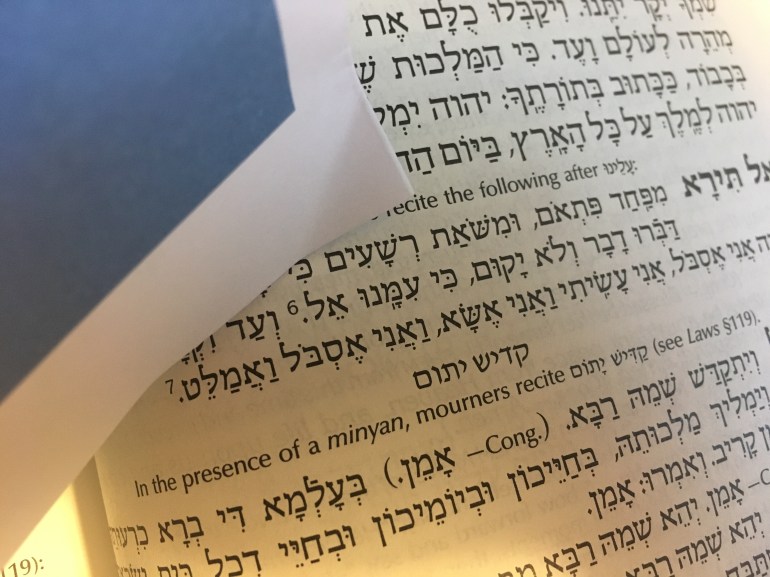
The Mourner’s Kaddish (Kaddish Yatom) has been bothering me for a while. An ancient Aramaic prayer that is traditionally said in community during certain prescribed times of mourning, it is a regular part of daily prayer. Yet this traditional prayer for the dead doesn’t mention death and barely mentions life. This oddity is often mentioned with a cluck of the, ‘Gosh isn’t that interesting?’ flavor. It’s hard to know what to make of it.

The bulk of Kaddish Yatom is in fact dedicated to praising the name of G-d, which seems like a perfectly great thing to pray, until you remember that we humans don’t know — can’t know — the name of G-d. It is both impossible and forbidden (hence the use of terms like G-d or haShem or יי). One of our most important and central prayers is the original mystery wrapped in an enigma.

When in mourning, we are called upon to say Kaddish Yatom five times a day, which means five times a day we essentially say, “I’m going to praise and glorify this thing I don’t know, this thing that nobody knows.” And that’s supposed to help. What does it even mean, to glorify something we are not permitted to know? It troubles me, because it feels like the moment of mourning a death should offer something more certain, something life-affirming or hopeful. Instead we’re commanded to say, essentially, “I have no idea, but I’m going to praise anyway.”

I just returned home from the funeral for a 21-year-old young man.

I think we all need to sit still with that sentence for a while.

I did not know the deceased, but we shared a community. He leaves behind a grieving, shocked family: parents, three sisters, three of his four grandparents. His grandfather — his grandfather — chanted El Malei Rachamim.

We probably need to sit with that one as well.

This bright, sweet, loyal young man died of an accidental opioid overdose. He decided last Saturday night to take a couple of pills. As his mother said, “He thought he could just try it once, without consequences.” The devastation and trauma that will follow in the wake of that risk can barely be contained. The questions of what life might have been like had he not made that foolish, understandable decision will haunt his family forever.

Soon these kind, conscientious parents will bury their child and begin saying Kaddish Yatom like they’ve never said it before. What will this mysterious prayer, this recitation of question marks, bring them?

The answer lies in the rule that a mourner cannot recite Kaddish Yatom without a minyan, a group of (at minimum) ten people with whom to pray. Every time these bereaved parents say Kaddish for their son, they will be surrounded by people who are there to hold them up when they can no longer stand.

I hope and pray this is enough.

Zichrono livracha, may his memory be a blessing. And may families never know this kind of sorrow again.

Praying for Myself

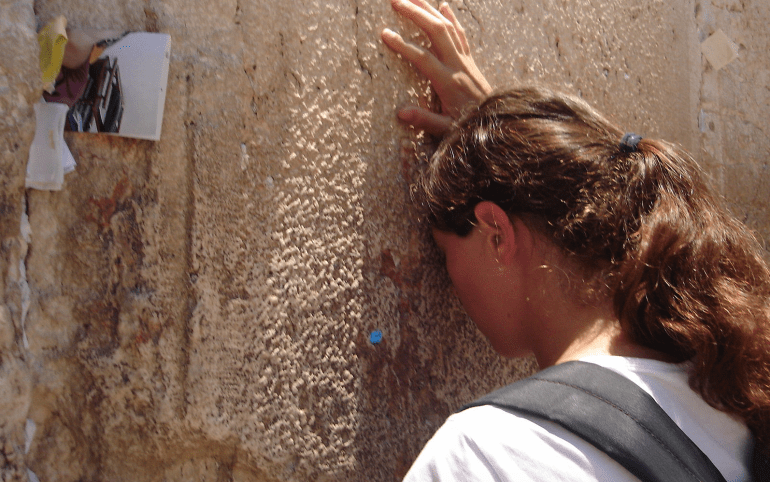
As part of my midlife crisis exploration of Jewish learning, I have been pushing myself to attend weekday tefillah at least three times a week. I have begun this task from a place of almost painful ignorance. My children are more fluent in the prayer than I am (and take it for granted, as children do), but I am determined to better myself. Not for nothing is my first child named Akiva. I am discovering day by day – sometimes minute by minute – the ferocity and love that are required for lifelong learning.

Most days I go to the davening at Hebrew College, for convenience, variety, and familiarization with the Rabbinical School community. The tefillah there is a laboratory for the students to try things, which means I get to taste a lot of different flavors.

One flavor this week was thoroughly unique for me, and I find that I am still churning, much later. When I entered the room, the chairs were pushed back, leaving a large space at the center of the room for standing prayer. There were a few chairs around the edges of the room, but we were clearly meant to stand throughout, to the best of each person’s capacity. The davening had just begun by the time I arrived, so after I took a siddur off the shelf, I found a spot and tried to get centered, tried to feel OK.

The experiment was that everyone would simply use the time for personal tefillah. All around me were people wrapped in tefillin, in tallit, in their own prayer. Sometimes mumbling. Sometimes singing. Flipping pages.

And me? As a latecomer and one with the barest novice-level familiarity with the liturgy, I found myself feeling alienated and discouraged at first. Lost, actually. I had a siddur in my hand but I didn’t know where to start. Would people hear me? Would people be able to notice I was wandering from Hebrew to translation to looking out the window at the incredibly beautiful trees? Would the flipping of my pages somehow give me away as the impostor I still am?

I wanted desperately for someone to show me what page I should be on.

But also — I realized how much Rabbi Harold Kushner’s teaching that, “Jews don’t pray for, Jews pray with,” means to me. While I was surrounded by people I like, I felt in no way connected to them. Each person in that room, though we share so much, was turned inward and upward for that hour. Each person prayed at his/her/their own pace and volume. I felt so alone. I wanted to pray with.

It was the perfect prayer experience for the smartphone age: everybody absorbed in a private experience, regardless of communal surrounding.

I forced my mind to think about prayer, about using this time in service of the Holy. What would it mean to be fully in charge of my relationship to the Divine? Aren’t I already? Why aren’t I already?

And what if my service to the Divine finds its fullest expression in relationship and in community? Perhaps I am missing the Divine in that theology. If, at any given moment, it’s all about the people in the room, am I truly engaging with G-d?

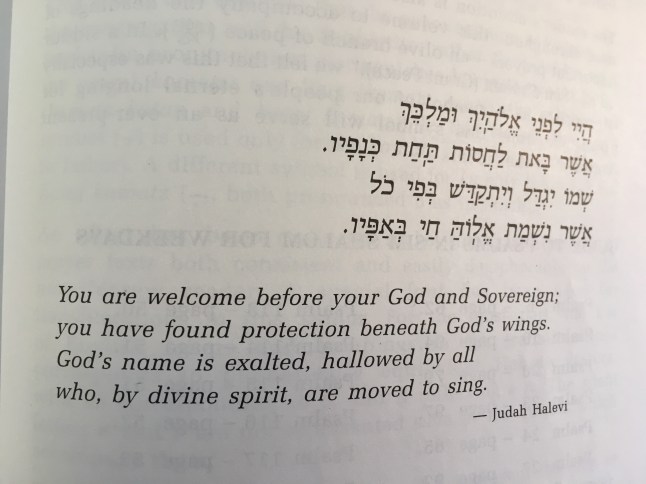
I opened up the siddur and found this.

Yehuda HaLevi from Sim Shalom

Is this the companionship I seek?

To be continued…

Tree of Life

The sea of words in response to yesterday’s barbaric shooting at Tree of Life synagogue in Pittsburgh hardly needs my contribution. As if the letter bombs and the grocery store murders weren’t appalling enough, this attack was the rotten cherry on top of a dreadful and violent week. We are heartbroken, we are reeling, we are searching for meaning and wondering where all this will end up.

Frankly I can’t deal with the big questions at the moment. I just have a few fragments of thoughts that are poking at me.

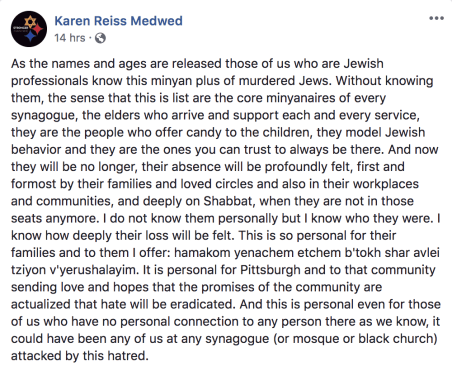
  • I’ve been thinking about the specificity of those who died, the people who showed up on time for shul. Karen Reiss Medwed* wrote about how every community has its on-time folks, the ones who arrive early and make sure the challah is where it’s supposed to be, greet guests, hand out siddurim and kippot. These are the behind-the-scenes people, the wonderful volunteers who care enough about showing up for others that they arrive early and stay late. Whatever is needed, they figure out a way to get the job done. In many ways they are the pillars of the community. And when the pillars are no longer with us, we must all stand a little taller to hold the community up. Every time we tuck the scrolls back into the Ark, we recite these words: It [the Torah] is a Tree of Life for those who hold it with strength, and all who support it are happy. I don’t know that we can find happiness just now in holding up the folks at Tree of Life, and by extension all who are hurting, but I do know we must do so.
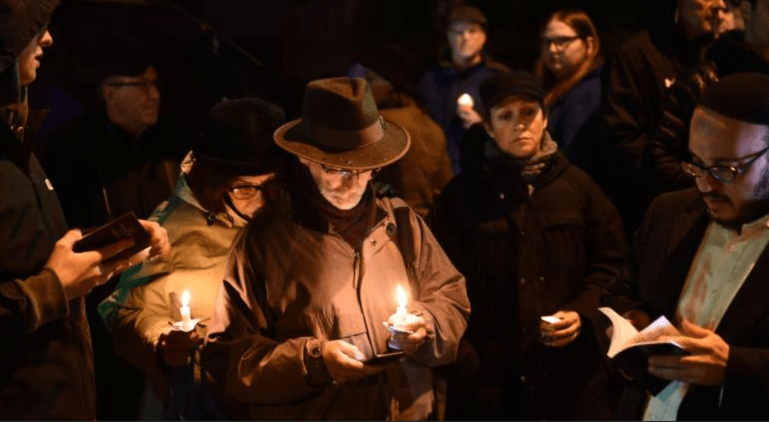
  • I spent some time today on Boston Common, attending the Vigil in memory of those lost in the Tree of Life shooting. I’m not a natural at these big gatherings. I get claustrophobic, so I like to keep moving. This means I get to see who is there and observe how people are responding. It was moving to see people who were clearly of different religious traditions showing up for us. I hope and pray that we do the same for them, for as long as it takes, until we no longer need to make vigil after vigil for completely avoidable losses. May that day come speedily.
  • The vigil took place just feet away from “Lest We Forget,” Luigi Toscano’s installation of Holocaust portraits on the Common. Nothing more needs to be said about that. Just sit in silence with it for a minute.
  • After the programmed part of the vigil ended, a moment of spontaneous singing erupted, like nothing I’ve ever experienced. It started with a small group of people singing, arms around each other and swaying in that Jewish way we can all picture. I didn’t recognize the song but I wanted to be in that moment. The circle quickly opened and grew, as more and more people were drawn in to participate. What started with a fistful of people ended up with probably close to 200. We just kept stepping back and opening our arms. We’ve been hearing a lot about how the shooter was upset about the congregation’s commitment to HIAS and to welcoming and assisting immigrants (as no doubt, many of them had been welcomed and assisted themselves). And we’d just been reading in yesterday’s Torah portion about Abraham’s model of hachnasat orchim (welcoming guests). The metaphor was alive and powerful. And then we sang Rebbe Nachman’s words about the world being a very narrow bridge and the essential thing being to have no fear at all. Bracing and beautiful.

I still have fear.

Screen Shot 2018-10-28 at 11.49.54 PM

in | between

For the first time in over a decade, we did not build our sukkah this year. Our sukkah parts are heavy and need to be put together by someone with height and strength. (I’ll pause while you snicker about my lack of both.) Most years, Bill has a day off work sometime between Yom Kippur and Sukkot and is able to do this. He doesn’t love it but he does it. This year, though, he had some extra work days at the store and you know the rest. Boys are uninterested in doing the work, so here we are.

In an O. Henry twist, for the first time in ages I have the luxury of time during Sukkot and no sukkah to sit in. My days are looser than they have been in a good long time, and while I have several projects that take up my attention, they are flexible to the time available and could totally be done while sitting in my sukkah in the golden autumn sunlight.

And yet in this time of in-between-ness, I scarcely need a reminder of impermanence. Where once I thought I would happily live out my remaining working days serving and building the community at Ohabei Shalom, that my work there would satisfy me indefinitely, those assumptions have crumbled, like the walls of an impermanent house. I am confident there will be another home for me, but what a rich and complicated gift to be in between at Sukkot.

You don’t get to go someplace new without leaving. At the moment I am far from the shore.

There is so much leaving and wandering in our tradition. Abraham leaves his father’s house and gives up his tradition in pursuit of what he knows to be true. Moses brings the people out of Egypt and forty years of wandering ensue. And the Torah ends with the end of the wandering. Or does it? The text actually gives us a cliffhanger: Moses cannot enter, leadership is transferred to Joshua, and then what? The topic returns to Moses. There is no mention of the people actually crossing over into the holy land. We are always becoming, always searching, always wrestling.

I am nowhere. I am now here.

Hineini. What’s next?

Belief & Sacrifice

Worshippers in many synagogues today read Akeidat Yitzchak (The Binding of Isaac). I have been puzzling over why this particular story is connected to Rosh Hashanah. It is so hard to read! I can’t imagine there is a parent anywhere who reads this passage and thinks, “Cool, I get it.” There could be no more painful commitment than the one that Abraham makes, to follow G-d’s instruction to sacrifice his beloved son. What, at this point, could he have had to prove? This is the Abraham who according to the midrash in Genesis Rabbah (38:13) smashed the idols in his father’s shop in order to help others understand the singularity and non-physicality of G-d, the Abraham who circumcised himself at age 99 (Genesis 17:24). This is not a man whose faith and commitment invite questioning.

Yet G-d asks the impossible of Abraham, to sacrifice his son, and he is prepared to deliver. The text rubs it in for Abraham: “Please take your son, your favored one, whom you love, Isaac, and go to the land of Moriah,” (Genesis 22:2) as if to make sure Abraham feels the full weight of what he is being asked to do.

Somehow Abraham is willing to take on this terrible task. And as Isaac starts to ask questions, Abraham keeps saying, essentially, it’s not ours to question. Let go and let G-d. Let’s go.

And the two walk on together, as one.

I keep asking myself what it would be like to have that kind of faith, to go forth with conviction that even the most incomprehensible, painful challenge is somehow going to turn out right, even useful. My brilliant teacher, Rabbi Marcia Prager, taught me that this story is a parable about walking in faith when the instructions are unclear.

In the end, Abraham and Isaac are saved, sort of. Just in the nick of time, an angel stays Abraham’s hand. Abraham sees a ram caught in the thicket. He releases Isaac and they offer up the ram instead. Afterward, G-d gives Abraham a blessing, that his descendants will be as numerous as the stars. His willingness to give up his son was enough to buy him a nation of descendants.

All’s well, right?

But notice! Abraham doesn’t go home. He stays instead in Beersheva. Perhaps he can’t face his wife. Perhaps he can’t face himself. Isaac disappears from the narrative for a while and for the remainder of his life struggles with trust. They are saved but they are changed. Although Abraham didn’t sacrifice his precious son, there was still a sacrifice that day.

I’ve been thinking about faith and sacrifice ever since the Colin Kaepernick ad dropped last week, the one whose tag line is: “Believe in something. Even if it means sacrificing everything.”
Screen Shot 2018-09-11 at 4.46.26 PM
I fully support Kaepernick’s right to protest and his method of doing so. With thoughtfulness and heart, he has brought our attention to some of the ways racism is still ruining our culture, more than 150 years after slavery ended in the US. (Slavery, I have come to realize, was not the disease, but a gruesome, near-fatal symptom.) His practice of kneeling for the national anthem before NFL games has sparked the national conversation about race that former President Bill Clinton aspired to all those years ago. It’s a conversation that’s not easy, but most worthwhile conversations are not. The level of anger that has been leveled at Kaepernick is shocking, a clear indication of barely veiled racism, and thus an indication of how necessary his work is in this moment.

Some people have taken issue with the protest, claiming that it denigrates both the American flag and US veterans. Respectfully, I disagree. Kaepernick’s protest has nothing to do with the flag, nor with the armed forces. It is a peaceful commentary on a problem in American society. Using his status as a public figure, Kaepernick has used non-violence to draw people’s attention to the horrific violence that is sometimes visited on unarmed black citizens at the hands of law enforcement. Despite suffering enormous professional and personal consequences, Kaepernick has stayed true to his principles, including that of non-violence.

Faith can make us do amazing things. It can inspire us to foolish greatness and it can spur us to great foolishness. The same zeal that moves people to make soup for the homeless and fight for immigrants’ rights also makes people fly airplanes into buildings. The confluence of Rosh Hashanah and that terrible anniversary should remind us that a deeply-held conviction is a double-edged sword. It’s great to be faithful, to be willing to go the distance. But Abraham learned that day that when you focus only on the sacrifice, you risk becoming blind to other choices, and when violence starts to look like a good solution, it’s wise to stay your hand and think twice. As Rabbi Sharon Brous said, paraphrasing Rabbi David Ellenson: always look for the ram in the thicket. The violent answer cannot be the final answer.