renew, return, recalibrate

Last night, Dena Weiss of Hadar gave a class at Harvard Hillel in preparation for the High Holidays. We took a look at Talmudic sources that could illuminate questions of how much atonement is the right amount, when it’s better to make apology and move on, what it means to see the same items on your cheshbon hanefesh (accounting of the soul) every year. ‘Tis the season.

Weiss made a compelling case for using these days of t’shuvah (return) with a gentle touch. Yes, we want to think about the things we have done and said that could have been better, more thoughtful, kinder, more patient, more compassionate. And yet we could also, Weiss argues, turn those desired qualities inward and give ourselves the compassion we strive to give to others. What would it be like to refrain from parading our picayune sins before our own eyes once they have been proportionally atoned?

We all have seen someone make such a show of apologizing that it starts to look like they’re a little in love with how it feels to apologize, perhaps even a little in love with the sin itself. This, Weiss argues, is not t’shuvah. It’s vanity. I would even suggest it’s virtue signaling.

For me, t’shuvah ought not be cumulative. If I say or do something unkind on Sukkot, I should apologize and make t’shuvah by Simchat Torah, maybe even by Sh’mini Atzeret. Like the missed dose of medicine that should be taken as soon as you realize you missed it, so too with a necessary apology. It’s when you save up all the missed doses until the Yamim Nora’im (Days of Awe) and wallow in the guilt of it all that you risk, frankly, overdosing on regret and self-recrimination in such a way as to blow the individual doses out of proportion. Maybe it’s cathartic, sure, but it risks veering toward being depressing or even performative.

The Midrash teaches that the first Yom Kippur arose spontaneously as a communal response to the shame and guilt of having built and attempted to worship the golden calf. Maybe the snarky comment you made to your sister-in-law that hurt her actual feelings was properly redeemed when you apologized with sincerity. Recalling it at Yom Kippur and apologizing again carries the risk of reopening a wound for both your sister-in-law and for you.

So if we take a pay-as-you-go approach to t’shuvah, what are these days for? If we apologize as soon as we realize we should, and do so honestly, what’s left for atoning? Is my cheshbon hanefesh actually clean if I just make it a point to do t’shuvah proportionally and within the statute of limitations?

Nope. Not so fast.

I would argue that the Days of Awe — and the month of Elul that precedes them — are when we are called to level up and look at the constellations rather than the stars. Those moments of making prompt apology — are there themes that keep coming up? Do they involve a topic that is troubling me more deeply than I’m willing to admit? Do they tend to involve one person? One type of person? Do they come about when I am in a particular state or situation? (Hangry? Moi?)

In a meditation class I took a zillion years ago, the teacher admonished that the finger pointing at the moon is not the moon. I’m still puzzled over that, but here it seems clear that the small- to medium-sized sins that are attended to (relatively) easily in the moment might be pointing to the bigger questions, those where cheshbon hanefesh takes on its real meaning.

Returning to the metaphor of the medicine, maybe Yom Kippur is our appointment to recalibrate our dosage. If we know we tend to be snarky to our children when they come into the kitchen asking for a snack while we’re making dinner (I’m just saying) of course we should continue apologizing every time we do the same damn thing and snap at them, but maybe we could also have a gentle word with them about patience and self-sufficiency…and make sure the fruit bowl is well-stocked.

If we know that we squander opportunities for genuine connection with others because we are embarrassed by thus-and-such or because we think we could never bridge the gap we perceive between us, it is time to recalibrate. If we know that there’s someone who has been on our minds for months but we’ve never quite found the moment to get back in touch, it is time to recalibrate. If we know there’s chesed we could be doing but aren’t, it is time to recalibrate.

And if we know that we continually deny our own dreams, bypassing a half hour of study or Hebrew practice in favor of making one more semi-clever comment (or a thousand) on Facebook, it is time to recalibrate.

Elul Writing: The Notes in my Pockets

PROMPT 12: The beloved R’ Simcha Bunim is perhaps most famous for using the pockets of his garments in order to embody the paradox of our existence.  As Buber recounts, Rebbe Simcha Bunim would teach:

Everyone must have two pockets, with a note in each pocket, so that they can reach into the one or the other, depending on the need. 

When feeling lowly and depressed, discouraged or disconsolate, one should reach into the right pocket, and, there, find the words: “For my sake was the world created.”

But when feeling high and mighty one should reach into the left pocket, and find the words: “I am but dust and ashes.”

What two truths do you need to hold in your pockets as you approach the new year? Perhaps they are in conflict with each other (e.g. you are happiest when you’re helping others and you need to practice saying no). What does it feel like in your body to move through the world carrying paradox with you?

This has been an unsettling week. In the past few days, I have received news about people I care about, news that is, frankly, shocking. Two people I am connected to are involved or suspected to be involved in serious wrongdoing, as perpetrators. I do not intend to write about the events themselves, at least not publicly, because in neither case is it my story to tell. I will say instead that these revelations have shaken me up and forced me to consider a new way to think about the truths in my pockets, the sometimes-conflicting core beliefs that guide my thoughts.

It rocks my foundations to think that people I know, or think I know, might have done terrible things. It is hard to absorb. At the same time I am praying that the accusations are untrue, I am wondering if they could be. I literally shudder to imagine it, and yet it is also hard to imagine that the accusation came from nothing. What kind of person does this kind of thing? What kind of person invents this kind of story? How can this be happening? It doesn’t add up.

If the accusations are true, what happens to the decades-long affection that I have felt for this person? Was I wrong to feel it? Are there sins that are unforgivable? If the accusations are untrue, is it a sin to give them consideration?

Near my home town, there are two billboards that have always caught my attention. They say, “Every saint has a past,” and, “Every sinner has a future.” Although the taxonomy of the phrasing is decidedly not Jewish, these signs contain a truth that is echoed in Jewish thought. They suggest that even the worst offenses do not tell the full story of a person. This is what I am clinging to as I wait for the truth to become clear, and they suggest one of the notes in my pockets:

All life is precious and t’shuvah is always possible.

The other note?

You never know what demons are inside a person.

To think and to do

PROMPT 10: What are you committed to thinking about in the coming weeks? Make a list. Forget the ‘to-do’s’, today we’re going to focus on the ‘to-consider’s’ (so much less intimidating!). When you’re done, ponder how you might turn deep thoughts into soul-liberating transformation.

Inspired by the aptly named Rav Kook, this prompt from Rabbi Jordan Braunig places value on the very act of thinking and ties it to the potential for transformation. I have had a lot of time to think these past two weeks, and it has, I must say, been blissful. (And with all the Aretha Franklin z’l video clips going around the internet since her death a few days ago, this prompt gives the clip from the Blues Brothers movie a little extra zing.)

So here are some things I might think about, considerations to consider.

  • Being a better partner to my husband: He has supported my every ambition and brings music, humor, and excellent cooking to our home on a regular basis. I think I will try to be nicer to him.
  • Being a better mother to our sons: They are pretty awesome. Sometimes I am grouchy. More often than you might think. I think I will try to be sweeter to them.
  • Calling my parents more frequently, but not so frequently as to get on their nerves.
  • Being more involved in the various communities in which I find myself: participating in chesed, volunteering to help organize things, being more of a leader.
  • Approaching my job search with a balance of passion and equanimity: passion in choosing what to try for, and equanimity in handling the inevitable rejection that is inherent in this process.
  • Keeping my heart open for insight and inspiration.

Blast

Another piece of writing inspired by Rabbi Jordan Braunig’s Elul writing prompts.

PROMPT 8: As we start this new week, I invite you to write that first blast of tekiah for yourself.  Journal about a moment of joy and completeness and success from this past year. Is there a moment this year that you can put your finger on where you experienced a sense of wholeness? Sing the song of that moment!

I spent the week after Tisha b’Av — the first of the seven weeks of consolation — at the Isabella Freedman Jewish Retreat Center in Connecticut. I was there to expand my learning about prayer leadership, through the DLTI (Davvenen Leadership Training Institute). This transformative week couldn’t have come at a better time. I arrived at the retreat badly in need of consolation, unsure of my future, afraid and alone. I knew that my job was ending. I knew that was the right thing. I had no idea what would be the next right thing, and that weighed on me.

I still don’t, by the way, but I feel much better.

Part of what helped was being at DLTI and having a safe environment in which to begin unpacking my conflicting ambitions, desires, hopes, dreams, fears, and practicalities. During that week, a purposeful prayer community developed. Though the people in our group came from many backgrounds and each had a different story and path, we shared a common purpose for the week: developing our skills in the leadership of prayer. We prayed together three times a day, studied the siddur, learned music both traditional and new, walked in the woods, talked, laughed, ate, stretched.

In the evenings, after the day’s planned curriculum concluded, a small group of us gathered in the lounge informally and sang late into the night. I called us the Shir Els, and nobody objected. There was some serious musical talent in the room, young people with guitars and songwriting credits and heart-stoppingly beautiful voices. First few days I barely opened my mouth.

But I grew.

downloadOn our last morning there, as we were waiting for a session to start, Joey Weisenberg’s Kol Haneshama was noodling around in my head. I started to sing. As I got into my groove, I caught the eye of someone across the room, who was singing too. We spurred each other on. A few more jumped in. The harmonies started to fill out — the two parts of the round intertwined like the strands of your grandmother’s challah. Rabbi Shawn Zevit found us on his guitar and kicked the groove even higher. Chairs became drums, the spaces between the seats somehow made room for the liveliest dancing this side of your wild cousin’s wedding. Clapping and dancing and singing. Pure joy.

That’s when I knew it was possible. That’s when I felt that whatever is unfolding will show me my path.

Elul Writing: If it’s broke, fix it yourself

Here’s another installment in the Jordan Braunig writing prompt extravaganza. It’s not too late for you to jump in, people!

PROMPT 5: Each of us comes to this with an element of brokenness, how can the arrival of this month allow us to imagine an ascent and a return to fullness?  What are the deep challenges that you face in shaping yourself this month?  What stone-carving-hard-work are you willing to do?

Ahhhh, the challenges I’m facing. Nothing too major, just trying to understand who I am. I wouldn’t worry about it if I were you.

My work for Elul (and beyond) is searching for a better sense of what I am meant to be. Over the past few months I have had the utter joy of encountering some people who are so exactly right in their own skin, it’s as if every molecule of them is lined up perfectly. They could not possibly be anything other than what they are.

I do not feel that way. I want to.

Lately I’ve come clean about my desire to deepen my Judaic study, an itch that’s been growing for several years now and that waxes and wanes but never seems to go away. Over the past several months I have been more public about this question, for better and worse. Now there is practically an army of people who have gotten on the “Naomi should be a Rabbi” bandwagon, which is lovely. I am often on that bandwagon myself. And yet, the stone-carving for me is, I think, to discern whether the bandwagon would exist if I were the only one on it. It’s great that my friends support me in the aspiration to become a Rabbi, and I couldn’t be more grateful for the encouragement.

But ultimately I’m the one who has to do the studying and make the sacrifices and find the money. I need to know that it’s a journey I take on for its own merits, a covenantal choice, rather than an ego-driven one.

I have doubts and certainties all at the same time. The stone-carving, soul-carving work is in waiting patiently to see when things come into focus and all the molecules line up.

Elul Writing: Spiritual To-Do List

Herewith another installment in response to Rabbi Jordan Braunig’s Elul writing prompts. If you’re not subscribed to this and you enjoy good writing — whether creating it or reading it — I highly recommend. Jordan’s introductions are at least half the fun!

PROMPT 3: Today, I invite you to spend an early moment in this month of self-growth and recreation, setting out a spiritual to-do list.  What concrete actions can you incorporate into these coming weeks that will help you feel anchored and prepared.  Perhaps you are aiming to experience silence every day.  Or, there are books and texts that you want to return to.  Maybe you want to wake up to the blast of the shofar.  While you’re at it, find space to take note of important conversations you want to have?  Give yourself a mix of easy and more arduous goals, so that you can feel the satisfaction of working your way through the list.

This instruction overlaps so neatly with the rest of my life, it’s almost tempting to just scan my to-do list in and call it a night. I am blessed at this moment with the opportunity to take a little time and space to discern what my next right step will be. Will I plunge back into the work world with a full-time, high-intensity job? Will I parlay the skills I’ve amassed in these past five years and enter the consulting arena? Will I pursue part-time work and test-drive rabbinic study?

I am eager to fill my days but not too soon, and not with just anything. I want magic!

While I scan the job listings and imagine what might be out there that fits me, I am spending time each day with the siddur. Along with polishing my resume, I am scheduling daily appointments to read about elements of worship I hadn’t considered. As I reconnect with my network, I’m also reconnecting with my tradition. And between coffees with colleagues, I’m preparing for a gig co-leading services on Kol Nidrei and Yom Kippur.

The to-do list is delicious: study the translations, learn the music, follow the bibliography trail, think, write, study, sing. I make a goal each day of words to explore, phrases to digest. One from Column A, one from Column B. Something in the siddur, something in Rabbi Hoffman’s book, a few phrases in the N’ilah liturgy. Back and forth and back and forth I go all day.

It is all too easy to think that this nice study smorgasbord is the Elul work. What’s essential, though, is to keep the spiritual frame on these daily habits I am trying to cultivate. There is a difference between studying the prayers and praying. Technical mastery is important, but there must also be room for holy mistakes. To allow for unstructured contact with the Divine, the contact that is at my current skill level, not my aspirational one, is part of the task.

Make holy mistakes. This is the to-do list on top of the to-do list.

Elul Writing: Pat B’Salo

This year I am subscribed to Rabbi Jordan Braunig’s Elul writing prompts. So close to Kol Nidrei I’m not making any vows, but I’m going to try to do something with this nice infusion of Elul creativity. This blog has been fallow for far too long, and it turns out that leaving one’s job opens up a lot of time for thinking and writing.

PROMPT 1: On this first day of the month of Elul, let’s play with the notion of pat b’salo/bread in one’s basket.  The sages teach that we should provide a traveler with bread for their basket.  Of course, a baguette or a boule would not be enough to nourish a traveler in any sustained way; but the knowledge that one has some provisions might allow them to travel farther and with more confidence.  So, as we take our first steps on the journey into this month of reflection let’s toss a little bread in our proverbial baskets.

What are you carrying with you already that is a source of sustenance and nourishment?  What gives you confidence and surety that you will eventually arrive in the place you hope to be?

This question really makes me sing, and makes me think. Being at a moment of transition at this point in the Jewish year is full of nuance and possibility. In the job I just left, there were moments when I felt woefully inadequate, even at times like a failure. Moving into job search mode can also awaken that troubling feeling of not being enough, even as I try to keep the notion safely boxed in.

Of course I’m not the only person — not even the only privileged white lady — dealing with uncertainty and transition. There are people in my circle dealing with major marital upheaval, with surprising career shifts, with illness, with soul-crushing loneliness. That doesn’t even begin to address the people who are suffering under current political or economic conditions — those afraid to love who they love or live where they live.

Where might we all find hope? What is the bread for our baskets?

As I search my own basket I find certain crumbs that never leave: my family, my friends, my faith. Even in the most difficult situations, somehow these three keep me from feeling spiritually impoverished. And in my theology the three are braided together. The acts of chesed we each do for one another are a reflection of the face of G-d. One of my favorite lines in the liturgy is the last line of Adon Olam: Adonai li v’lo ira. I have G-d and I am not afraid.

That is the bread in my basket.

Thoughts about being #togetherandfree

I was on the “better late than never” plan for yesterday’s demonstration at City Hall and the Boston Common. Given my druthers, I would have stayed in bed all day. I felt it important to show up, however, to protest family separation and the travel ban. Despite feeling depleted and antisocial, I was spurred by anger, sadness, and more than a little guilt. While my greatest anguish over my children is that their pictures don’t show up enough on the camp website (seriously, they don’t!) I cannot rest while there are parents who have been forcibly separated from their children. I sometimes have the sense that the other side is counting on our exhaustion. I can’t be part of that. Even though I am truly exhausted. My tradition teaches welcoming the stranger, not as a platitude, but from the earned empathy of having been strangers in the land of Egypt.

Armed (haha) with my usual slogan, I set out for the T.

Maybe it was the heat, or maybe others were feeling the same marching fatigue that I’ve been feeling, but the energy on the train was muted. It was clear to me that we were headed for the same place but that perhaps this week, on top of the previous 75 weeks, had momentarily dimmed our spark.

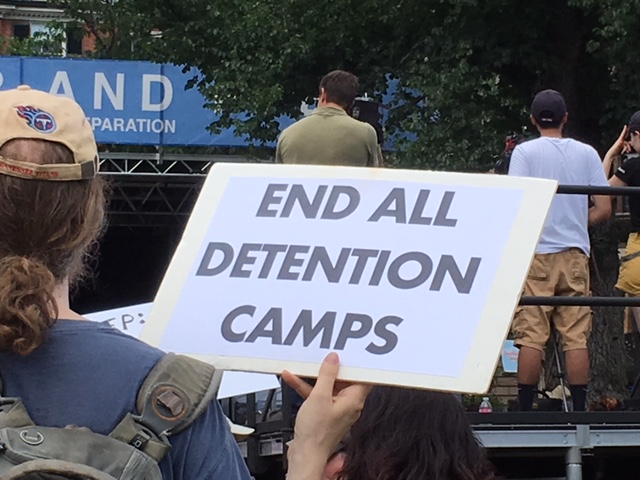
Still, I saw glimmers – even felt a few of my own. People showed up, some of them looking as bedraggled as I felt. Although there will always be clever protest signs, the ones that really caught me up this time around were the plaintive ones.

I really have no words to add to these. That they would even need to be written in a society that purports to civility boggles the mind. Knowing the longing that I feel for my sons, my no-longer-baby sons, even when I know where they are and when I will see them next, urges me on. Seeing that the woman on the left feels the same longing for her parents as I feel for my children is all I need. It should not be a privilege to know where your children are, and to share your life with them.

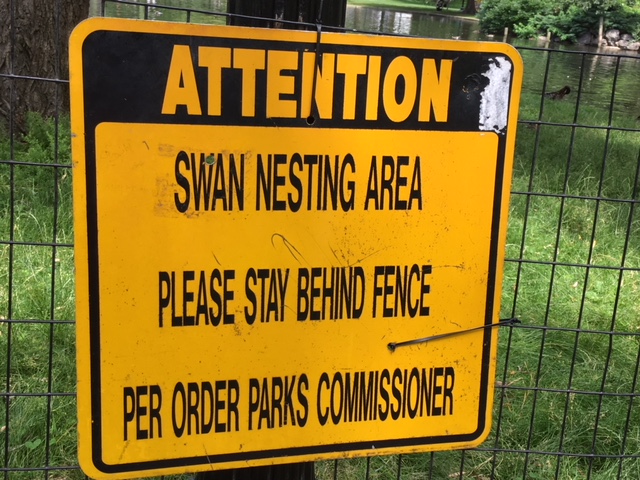
Meanwhile, across the street in the Boston Public Garden, I saw this:

It is perhaps discouraging that it’s easier to support swan families staying together than human families.

We must continue to show up, march, call our representatives, write to the newspapers, donate to the campaigns of politicians we feel can make a difference.

I am the product of a Jewish education…but not in the way you think

When I was a child, my Jewish education was spotty at best. I had a firm sense of Jewish identity rooted mainly in food and family. (Not for nothing, but my mother’s chicken soup is better than all other chicken soups, in this world and the world to come.) With respect to Jewish learning, though, the story is like a wikipedia stub article: a year or so of Hebrew school at a shul we never attended, learning with kids I didn’t know. I might or might not have gotten kicked out of class so many times I had an endowed seat in the principal’s office. In a plot twist rare in synagogue life, I dropped out of Hebrew school before Bat Mitzvah age.

As I grew older, into my twenties and even my thirties, I was constantly trying to connect to Jewish life and constantly thwarted by that awful feeling of being “not Jewish enough.” In every Jewish context I found myself in, I seemed to be surrounded by people who knew their stuff and knew each other. I became an adult with a strong internal pull to connect with my heritage and without the background or knowledge even to start.

When I became a mother, the longing I felt for my Jewish identity inspired what might seem like an odd choice for someone so far off the derech: my Jew-by-choice husband and I decided to send our children to day school. What informed this choice, for me, was the aching desire for my children to feel that they own the tradition, that it belongs to them and lives inside them, and that they have a right to be in any Jewish context they choose to inhabit.

We settled on JCDS just as the bottom tumbled out of our world. Where our existence before October of 2008 was one of privilege and plenty, we experienced a reversal of fortune in the great recession and found ourselves without resources and without skills. Neither of us had ever held a grown-up job (actor doesn’t count!) and with two young children and no income, we needed urgently to set about the task of regaining our foothold.

Even so, our commitment to providing our children with a Jewish education remained firm, and by hook or by crook, we pieced together the tuition deposit to enroll Akiva. Every sacrifice has been repaid thousandfold.

In our early days at JCDS, I was consumed with that “not Jewish enough” feeling: a vague dread that permeated my every encounter. Despite feeling like an impostor, I was continually touched by the kindness and welcome that characterized the school community. Gradually I began to feel I belonged, and that there was hope for me to move beyond the stunted Jewish identity of my childhood and into a fuller expression of my Jewish self. Akiva made friends with others in his class, Shabbat invitations came, and before I knew it, we were part of a community. As I took advantage of the many offerings for parents at JCDS – parenting discussion groups, Hebrew for novices, Torah study and more – my sense of connection grew and grew. Through these intimate encounters, it wasn’t just that I started feeling more comfortable in my Jewish skin, it was also that I started to develop a sense of what it means, and what it takes, to be in community.

When hard times came, we found ourselves supported by that very community. One year, in Bill’s busiest season at work, I was diagnosed with pneumonia and bronchitis. The boys were little enough that they couldn’t help with cooking or housework, but the JCDS community swept to the rescue, delivering meals, offering rides to school, and generally cheering us up with constant love and kind attention.

I started to volunteer at school, out of appreciation for what was offered and a desire to give back. Although I lacked the background in those early years to lead a study group or similar, I did discover within myself an aptitude for what I eventually learned to call community engagement. As a worker bee, as a committee chair, and eventually as the Chair of the entire Va’ad Horim (Parent Association), I organized and publicized programs, published a popular weekly message, navigated the dynamics of true religious pluralism, and learned to work effectively with volunteers and administration alike. I was endlessly energized by this work. Quite by surprise, I had found my calling, and when Gideon started school, I joyfully entered the profession of Jewish communal service!

While I was channeling my inner extrovert, I was also discovering my inner scholar. Through participation in Torah study, I began to find my voice as a learner. This, in turn, gave me courage to begin facilitating pluralism discussion groups. The more I learned, the more I learned. Gradually I have become more comfortable speaking up in Torah study, developing study skills to match my curiosity, beginning to chant Torah, attempting to write divrei Torah, even occasionally leading services at the Reform synagogue where I work. People now think of me as an accomplished learner, someone who knows her stuff. Shockingly, there are times when people who didn’t know me before think I am a Rabbi. (I should be so lucky!)

JCDS has played a significant role in the development of my adult Jewish identity: as a learner, a teacher, a friend, a professional, and – most importantly, perhaps – as a person who knows, lives and transmits the value of Jewish community. I couldn’t possibly be more grateful.

And Justice for All

There is a passage in Bo, this week’s parsha, where Moses & Aaron are negotiating with Pharaoh for the freedom of the Israelites. There have been already seven plagues against the Egyptians — blood, frogs, lice, wild animals, cattle disease, boils, and hail. Following each curse, Pharaoh suggested he was ready to relent and release the Israelites, only to change his mind yet again. After the hailstorm, Moses and Aaron are told they can go, on one condition. Only the men can be released; women, children, and animals all must remain enslaved. Exodus 10:10-11 says, “But he [Pharaoh] said to them, ‘The Holy One be with you the same as I mean to let your children go with you! Clearly you are bent on mischief. No! You men may go and worship the Holy One, since that is what you want.'”

Pharaoh’s arrogance and skepticism about G-d is manifest in these lines, as Pharaoh assigns the same likelihood of the Holy One being with the Israelites as he does to the likelihood of the children being permitted to go worship as they wish. He clearly does not mean to release the entire population of B’nei Yisrael, anymore than he regards the Israelites’ G-d as being real. It’s even more cynical than that. This particular gambit is meant to ensure the destruction of a people. Were Pharaoh to release only the men, B’nei Yisrael would die out within a generation.

Later in the parsha, Pharaoh offers all the people but not the animals. Yet in an agrarian society, this, too would have spelled annihilation.

Moses and Aaron recognize a bad deal when they see one, and they refuse to leave without the whole of their society.

In many ways, we are in a similar moment now. The Pharaohs that hold us back – racism, sexism, xenophobia, homophobia – have given us a bit of progress in the hopes we’ll go away and stop asking for more. We have made strides, there’s no doubt: We have, thank G-d, moved well beyond drinking fountains and buses and share many spaces across cultures, genders, and orientations. Women, African-Americans, LGBTQ people, and immigrants take leadership roles in their work lives, have their relationships acknowledged and affirmed, and speak out against injustice. A century ago, we couldn’t have imagined that the Supreme Court would be made up of anything other than old white men. Fifty years ago, it was impossible to predict a woman could direct a major film, run a Fortune 500 corporation, or earn the majority of the popular vote in a presidential election. Even as recently as a generation ago, having an African-American President of the United States would have been unthinkable.

These hard-earned victories are symbols of the slow bend of history’s arc toward justice. Yet that bend is slow indeed. Today, high government officials and private citizens alike use vile language to talk about black and brown people, language that betrays the racism that still roils this country. LGBTQ people are discriminated against in large ways and small, from gay bashing (yes, it still happens) to refusal of service. In the #metoo era, we must reckon with the appalling history and present of men in positions of power pressing their advantage over others in humiliating fashion. And policies continue to be put in place that jeopardize the health, safety, and well-being of many in our country, in favor of the profit and security of a few. We are a long way from the shore, and right now the winds do not seem to favor us.

In many ways, we hold little power. Yet we can engage in small, meaningful actions. Today, in honor of Martin Luther King Day, the entire community at my sons’ school spent the day in learning and action on the theme of social justice. The tefilah was complemented by relevant King quotations and tunes reminiscent of the protest era, children heard from speakers connected to social justice and protest movements, and the entire school spent the afternoon engaged in direct acts of service, preparing gift packets, school supplies, and dinner to be delivered to a family shelter. The boys came home from school and went straight to their tzedakah boxes to make a contribution in Dr. King’s honor. (They chose the NAACP.)

Something else we can do is mind our words. This morning I attended the MLK Day of Learning and Service at Brandeis, sponsored by Cooperative Metropolitan Ministries. One of the sessions I attended was on microagressions, those small slights and insults (both intentional and unintentional) that are strong enough to cause offense but subtle enough to be deniable by the speaker. This topic has been much on my mind lately, as I search my conscience for ways in which I have tried to be kind and missed the mark. A recent experience has made me especially introspective about it.

Before I had heard about the H&M monkey controversy, a dear friend posted to her Facebook feed about her astonishment that white parents call their children monkeys. I waded (nah, stomped) into the conversation, saying how much I loved calling my children monkeys and what it meant to me in the context of my family. My friend very patiently suggested I learn more about the history of white people calling black people monkeys. Which I did. Hint: it should be the M word, because when you call a human being an animal and tell them to go back to the jungle and you know that in this case “jungle” means the home continent from which their ancestors were kidnapped and enslaved…it’s not so cute.

It is my privilege as a white person that I didn’t need to know about this history. For me, that word was neutral, even sweet. Yet for my friend, and for others whose people suffered the holocaust of slavery, it is anything but. As I came to understand this, I realized I couldn’t continue to use that word for my children, even though to us it is a loving expression. Ultimately, any word that causes pain to others is not a word I want to use. This led to a beautiful conversation with the boys, in which I told them what I learned and the three of us easily agreed that it simply wasn’t worth it to express our love in that way. I have slipped a couple of times, and they have reminded me. A thirteen-year-old habit will not end without hiccups. Yet I am committed not to continue this microaggression and am grateful to my friend for teaching me.

Just as Moses & Aaron rejected Pharaoh’s offer to allow only some of the Israelites the religious freedom which they all craved, I reject the notion that the only insults that matter are the ones that hurt me, or that the only societal problems I should care about are the ones having to do with me directly. As civil rights activist Fannie Lou Hamer said, “Nobody’s free until everybody’s free.” Our Torah teaches us to pursue justice, and so we must continue to reject the partial offer. When it comes to equality, it means nothing if it does not include everybody.