Back to Basics

My friend and colleague, Rabbi Audrey Marcus Berkman, has given me the honor of chanting Torah on Yom Kippur afternoon at Temple Ohabei Shalom. It’s a short reading — just four p’sukim — but full of richness. The reading comes from Leviticus 19, the beginning of what’s known as the holiness code. In it, G-d tells Moses to speak to the entire community of Israelites in order to teach them why and how to be holy. The why is (deceptively) simple: the people shall be holy in imitation of their Creator. The how takes up many, many p’sukim to follow, but my portion is refreshingly basic: revere your mother and father, keep Shabbat, and do not turn to idolatry.

As so many things — family, work, nation — seem to swirl into ever more confusing and complicated duststorms, it is a gift to return, in this season of return, to core teachings. My daily life can sometimes seem a series of fire drills, panics, dramas, and interruptions upon interruptions. How glorious to focus my mind on basic reverence: for my elders, for my tradition, for my Creator.

On Sunday afternoon, Bill and I took the boys to the river to do a family tashlich. As we stood in a clearing in the woods, we talked about what we wanted to throw away from the past year and what we wanted to do better. What struck me — with both hope and rue — was how much our comments resembled those of years past. The things we want to do less of in the coming year — arguing, thoughtlessness, impatience, meanness — are exactly the things we wanted to do less of in the year just ended. Did we really do such a bad job at it the last time (and the time before and the time before the time before) that we have to try yet again this year? It is discouraging to name the same things year after year, to set the same intentions as the year before and know that I’m likely to be setting (or re-setting) them at the same time next year.

Shouldn’t we be keeping these basic intentions in mind throughout the year?

And yet I love the way our tradition builds this habit of introspection into the calendar and offers us this annual chance at realigning ourselves. These ten days of awe give us a wonderful opportunity to remind ourselves of what matters most to us, and to get back to our basics.​

Darkness at Two

Sometimes everything comes at once, and sometimes the natural world can provide you with a perfect metaphor for viewing it all. Today we will experience darkness at midday. In a rare solar eclipse, the moon will temporarily block the sun and daytime will look like night. Our tradition talks a lot about G-d’s power to create light and darkness and to separate the two. We read it in B’reishit, and we mention it in evening prayers. Jewish thought is a constant project of joining things which belong together and separating – making havdalah – those things which are distinct from one another. So when the sun and the moon appear so close in the sky that one crowds the other out, it warrants attention.

There could hardly be a more exact image for what we are experiencing as a nation. Dark forces are gathering on the ground and in the highest offices of government. White supremacists have removed their hoods and are unabashedly practicing intimidation. They get away with behavior that was once considered shameful, and they get away with it partly because the president himself equivocates as to the appropriateness of their actions. I have heard it said over and over, and I feel it myself: I never imagined that Nazis would openly demonstrate in American cities and not be unambiguously condemned. It is hard to fathom. Alongside friends from many communities, I go about my daily work in a state of disorientation. How did we come to this? How did it happen so quickly? Where will it end?

Yet there is also light. There always is. Even amidst the awful events of Charlottesville a week an a half ago, there were people who lent their support to the Jewish community there, standing shoulder-to-shoulder with security guards to protect the synagogue and praying alongside members of the shul. And here in Boston, over this weekend just past, we saw an astounding turnout – more counter-protest than protest – that turned back the forces of white supremacy. Their so-called free speech rally, a thinly-veiled show of white supremacist force, withered in the daylight, as tens of thousands peacefully demonstrated their commitment to diversity, acceptance, and kindness.

The partial eclipse we will see in Boston is the very picture of how our city refracts the national mood. The darkness is still there, but more than a little light will peek out. Though day feels like it is becoming night, the transformation will not be complete. We know that the white supremacist movement is out there, and that they think the guy in the White House is their guy, but those who would defend civil rights, women’s rights, human rights are still here, still fighting, and still determined not to see the nation fall prey to dark forces.

That tonight is Rosh Chodesh Elul merely sweetens the metaphor. In Elul, we turn inward and prepare ourselves for the refiner’s fire of the chaggim. Elul is a month of soul-searching, of peeling away the layers of excesses and irrelevancies to see what we are made of and what matters to us. What a perfect time to be doing so. (It always is!) As we make the transition from one year to the next and engage deeply in t’shuvah, we have the opportunity to examine our own assumptions, our privileges, and the ways in which we can redouble our efforts serve others with more love.

In Jewish tradition, our days begin in darkness. As darkness falls in the middle of the afternoon today – and then dissipates – let us all ask ourselves the urgent questions. What do we want from this new day? What can we do to bring about the change we wish to see in the world? In this moment, the forces of darkness are attempting to crowd out the light. The world needs you (yes, you!) to bring your mightiest effort to dispelling the darkness. Reach out to others in sincerity and humility. Be there for those who are in need, and allow for the possibility of t’shuvah, in yourself and in others.

With each day, this task becomes more urgent. A day like today – a day that starts twice – is the perfect moment to begin.

Finding our Place

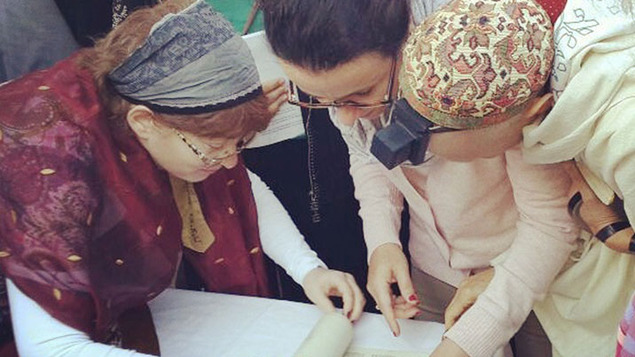
I’ve been thinking recently about being lost & being found. Having been to several B’nei Mitzvah lately (you’d think I have a 13-year-old son or something!) I have witnessed over and over again that lovely tradition that maybe you’ve seen so much you’ve forgotten to see it: the way that those gathered around the Torah scrolls help the reader to find his or her place, and the way the reader in turn shows the place to those giving the blessings for the aliyah. It’s a simple thing, but the metaphor is rich. Those who give voice to the teaching – and those who are gathered round to bear witness – they have each other’s backs. Sometimes the person seemingly in the driver’s seat needs someone in the passenger seat to read the map, to point the way, to say, “This is where we are now. You are among friends, and we will not let you be lost.”

The first time I received a call from a congregant whose husband was dying, I heard the pain and fear in her voice: “Naomi, I’m lost. I don’t know what to do. Charles is dying and I don’t know where to start.” I had been to visit with him recently, so I knew that this was not a surprising turn. Still, when it is real, it is real. With all the courage I could muster, I said to her, “I’m lost too. We’ll be lost together.” I spoke with her about calling the funeral home, about aninut and aveilut, about the value of sitting shiva, even though neither she nor her husband thought themselves to be religious. While she did not see herself as worthy of claiming that part of the tradition, I knew that sitting still with her community and allowing them to take care of her would benefit her in ways that she couldn’t imagine.

Sometimes confusion seems to swirl around us, and it is easy to lose our way. What anchors us? What holds us steady in trying times? For me, the answer is – always – community. When I am overwhelmed, or when I have more sadness than I know what to do with, nothing brings my life back into perspective like time spent in community, a call from a friend, or even just a thumbs-up on Facebook.

We read in Psalms: “Essa einai el he-Harim, I lift my eyes to the mountains. Where will I find help?”

For me, the help that comes from the people around me is the help that comes from Adonai. My community is G-d’s hands and feet, as I hope to be for others who are in need. Sometimes you’re the one holding fast to the scroll with sure knowledge of your place, and sometimes you’re the one whose eyes search and search. Knowing that we each have the capacity for both roles strengthens us to fulfill them. Go and learn it.

Interesting times

This week has been interesting. Chinese-curse interesting. Like the curse says, we are living in interesting times, and the events of this week leave me wracked and raw. It isn’t only that my candidate didn’t win – although that hurts – it’s that the meanness that this  campaign season has brought out seems to have no bottom.

Election campaigns are always negative and divisive: the very nature of the enterprise brings out the most competitive instincts in all of us. Candidates are typically people with strong personalities and deeply-held opinions, and the closer they get to the finish line, the more ruthless they become. That’s ugly but normal. At the same time, it is usually the case that once the race has been won and lost, there is a sort of reset button. People stop insulting each other and, at least for a time, they speak of reconciliation, unity, and patriotism. The loser concedes the race and encourages his or her followers to support the new president. We lick our wounds and move on with our lives.

This time it seems different. The level of nastiness and name-calling has not abated, and despite both President-elect Trump’s and Secretary Clinton’s calls for unity, quite the opposite is playing out. The day after the election, which just happened to be the anniversary of Kristallnacht, shop windows were broken and swastikas spray-painted alongside Trump’s name in Philadelphia. In sleepy old Wellesley, some frat boys sped around waving a confederate flag and intimidating folks. Even the banter on Facebook has been just mean. From friends I’ve known a long time, whose politics differ from mine, I’ve witnessed racist slurs and been baited and teased. Although not everyone has acted this way, many have chosen to, “go low.” The loss is more than an office.

I keep hearing people whose politics are like mine saying that we live in a bubble. It’s easy to think – whether you’re in Newton or Ann Arbor or meeting in the ether – that everyone in this country sees things as you do. This week has taught me how wrong and dangerous it is to be lulled into that notion. This great fractious nation is teeming with opinions and feelings and fears. The way others see the world is as real to them as the way I see it is real to me. I share none of the principles that the most vocal Trump supporters are espousing, but I must acknowledge their humanity and attempt to see others as deserving of basic rights…just as I wish that they would see “the other” as themselves.

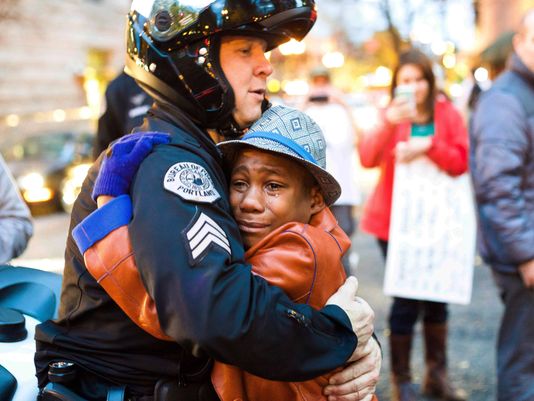
What to do about it? I wish I had a five-point plan. All I have is a general notion that we – all of us – need to overpower the hatred with kindness. We need to take the social risks, talk to strangers, smile at people who scare us, go where we don’t belong, defend those who are being intimidated or persecuted. We need to break the bubble before it breaks us.

Today is Veteran’s Day. We know the consequences of allowing disagreements to escalate into violence. We must make different choices. We have some terrible healing to do, and the work waits.

Renew

After this morning’s Rosh Hashanah service, at which I was both staff in charge and Torah chanter, I came home to have lunch with two grown-up boys. They’d started the cooking while I was out, and the three of us easily and naturally teamed up together to prepare the table and serve each other the food.

We set out on an errand walk after that – to the library and the grocery and then back home. With Little still little enough to hold my hand, it felt almost like being a stay-at-home mother again. There were multiple conversational threads, interruptions, silly jokes, singing – all perfected by the golden autumn sunlight.

There is a text we sing each week that never fails to catch in my throat: chadesh yameinu k’kedem. Though it is typically translated as, “renew our days as of old,” a dear friend taught this paradoxical line to me as, “Renew our days; make them like before.”

At this time of year, we hear that text more frequently and more insistently, as we contemplate what it means to start another year. We want more days, more time, yet it is hard to let go of the time already past. We want it new, but not too new, not at the expense of the sweet bits we already miss.

So when my afternoon turned unexpectedly into an autumn-lit walk with my two best people — those adorable, agonizing people who need me but don’t — it was truly a gift, a thick slice of heaven. As we made our way home, they decided to break away and race me home: them through the woods and me through the neighborhood. I gave them the backpack containing my phone and keys, and waved as they skipped ahead, chasing each other and giggling, a spontaneous Brother Party in the making.

I turned the corner and when I did, I saw a woman walking with two young boys: a toddler and a preschooler. They held hands, skipped, tumbled, laughed — and I saw in the glinting sunlight an echo of the old days, those days which can never be fully renewed and yet which sometimes brush against my cheek like a beloved ghost.

Echad

I’m scheduled to read Torah on the second day of Rosh Hashanah at the synagogue where I work. My aliyah is the very first one in the Torah, from B’reishit, detailing the first day of this world. It is the very essence of Rosh Hashanah, which some people call the birthday of the world. In these five short verses, the world begins the journey from chaos to order. (I’m not quite sure where or whether that journey culminates.) Separations are made, categories are drawn, things begin to be put in their proper places. Earth and sky get organized, and the lights go on. From the jumble of undifferentiated time comes evening and morning, a first day.

It is curious to me that for all the separation and categorization of this aliyah, it concludes, like the Sh’ma, with the word echad (one). There is a constant tension in Jewish thought, with separation and unity dancing around each other. We make a point of separating meat from milk, Shabbat from weekdays, the holy from the everyday. And yet we pray three times a day a reminder that there is one G-d, that our most important thought is the unity of the force that animates us.

Life, as always, is very full. As I work through the planning for the chaggim, I am making list upon list, categorizing and recategorizing. Sometimes when my mind gets overwhelmed with details, I’ll take a blank piece of paper and take all the scrambling thoughts and put them into categories. And when the scraps and notes on my desk pile up and threaten to choke the life out of me, I stack them all up into one big pile and make a fresh list, taking the gleanings from each scrap and giving them a fresh start on a new piece of paper. The feeling of knowing the landscape helps me know where to step first. Like G-d on that very first day, I separate the to-do from the done, and I survey it. Sometimes I can even say that it is good.

When chaos reigns, we cannot tell which end is up, just as on that first day of creation neither heaven nor earth was plain to see. Separating things into useful categories helps us see the spaces between – and that’s where the light is.

Yet when we look at the Sh’ma, we see that all the categories, all the days, all the meats and milks, the evenings and the mornings – all the things, as the young people now like to say – add up to the same thing. The One who created all the categories is somehow immune from category. For myself, the categorization creates the necessary breathing space so that I can feel the unity more clearly. The two seem to lean on each other in an interesting and paradoxical way. I don’t know what to make of this dance between separation and unity, and it pleases me to think that perhaps G-d needs both and values both.

As the new year comes barreling toward us, I wish us all the perspective to see the categories and the unity that underlies them. L’shanah tovah!

Department of Returns

With daily obligations seeming to expand exponentially, life sometimes feels like a treadmill of tech and striving. Don’t get me wrong: I love tech and I’m a born striver. (The treadmill, not so much.) But all that leaning forward can leave a person feeling off balance, and all that connecting (Facebook, email, twitter, and and and) can leave a person feeling oddly disconnected.

Our tradition gives us an amazing opportunity, just as the seasons turn, to slow down, pay attention, press the reset button. As Elul begins tonight, we begin to get off the treadmill and to make a cheshbon ha-nefesh, an accounting of the soul, in preparation for the High Holidays. We pay attention, individually and communally, to how we treat others and how we conduct ourselves. We ask ourselves a veritable GRE of questions: Have we been honest in business? Have we been open and available with partners, families, and friends? Have we taken time for contemplation? We pay attention to our choices with money and our choices with time. Have we given tzedakah to the best of our capacity, with thoughtfulness and dignity? Have we been there — not just molecularly but spiritually — for the people who need us? Are we making wise and thoughtful use of our one and only lives?

Our tradition teaches us that there is always room for t’shuvah (return) but at this time of year, from Rosh Chodesh Elul to havdalah on Yom Kippur, the ground is particularly ripe for it. A great resource I’ve returned to (!) the past few years during this time of reflection is 10Q from Reboot (the same people who brought you the National Day of Unplugging).

10QlogoFor 10Q, the Rebooters send you one simple-not-so-simple question per day for the ten days between Rosh HaShanah and Yom Kippur. The questions can be answered easily, but they invite the kind of pause that’s both meaningful and rare. At Yom Kippur, the answers are sealed up in an online vault, and as the next year’s Days of Awe approach, the vault is unsealed and the 10Q folks send you a link to review your answers from the previous year. It can be both thrilling and humbling to look at the past year’s answers and to see what changes and what doesn’t. The 10Q questions don’t change, but the answers do. And presumably we do as well.

In my line of work, it’s challenging to maintain a focus on the work of t’shuvah when I am busy creating the circumstances for others’ t’shuvah. I am determined this year not to lose sight of “the reason for the season” entirely. Here we go!

#elul
#offthetreadmill

Terms of Enragement

This past week has been nothing short of catastrophic. There have been people literally dying in the streets. Black men shot by police in what should have been routine encounters; police officers targeted by snipers at what should have been a peaceful protest. The soup of emotions is thick with anguish, terror, rage, resentment, despair. Social media is inflamed with people taking sides, arguing about whose lives matter. As if there is anyone whose life doesn’t.

The great Elie Wiesel, who died last week, once spoke of the importance of avoiding neutrality, saying that we must take sides. Yet that warning does not apply here, for it presupposes that there are sides. In the overheated media climate, it’s easy to oversimplify: If you speak out against police brutality, it must mean you hate the police. If you mourn the police officers who died protecting protesters, you must be racist. These are fallacies both.

There are no sides.

It is not enough to decry the killing of one person by another. It is not enough to mourn with a family that has suffered a loss. It is not enough to denounce a flawed system that distrusts and debases people on the basis of faulty assumptions.

It is not enough.

In this week’s parsha, Korach falsely accuses Moses and Aaron of elevating themselves above the community, saying, “You have gone too far! The whole community is holy, every one of them, and G-d is with them. Why then do you set yourselves above HaShem’s assembly?” Moses calls upon the Almighty to arbitrate, and Korach and his followers are struck down dead.

The message is clear: while Korach’s words sounded plausible, they were wrong. It is easy to speak in facile slogans, the more so at the speed of tweets. Memes abound, many of them containing a grain of truth, but ultimately it is only a grain.

We need words that heal. We need leaders with the humility of Moses & Aaron, people who can work through the rhetoric and polarization and lead in a spirit of service. We need — now more than ever — leaders who can inspire and insist upon the kind of honest, vulnerable, substantive dialogue that can bind us together as a nation.

Our society may have, in the words of T.S. Eliot, pushed the moment to its crisis. To move beyond the crisis, we need to realize that we are all hurting and that the relief we want and need can only come from, “joining hands, marching together.”

#blacklivesmatter
#bluelivesmatter
#enough

E pluribus unum

It strikes me as fitting that this year the Fourth of July falls during the week when we study Sh’lach-L’cha. It doesn’t always work out this way, but it seems particularly apt to me. As we read of the scouts who lit out for the territory to scope out Eretz Yisrael and report back, of the equal expiation rituals for stranger and neighbor alike, and of the courage it took to fight for the land, I hear American echoes and whispers.

It is of particular significance to me that the scouts are one from each tribe, with several verses devoted to the names not only of the scouts but of the tribes and parents from whom they came. This description of provenance, contextualizing each individual scout by family and by tribe, is echoed in our modern-day identification of Senators and Representatives, as in Bernie Sanders, D-Vermont. (You know, just for instance.) That each scout is named individually, yet they were sent on a collective mission, is such a beautiful metaphor for a healthy society: each of us brings individual qualities and histories, yet things work when we work together. E pluribus unum.

The current American climate feels to me ever more divisive, with an undercurrent of anger in even the most mundane of tasks. Waiting in line at the grocery, parking the car, expressing an opinion on social media — all these things and more are rife with contention. Advertisers, political candidates, entertainers (and people who are all three at once!) fan the flames of this contention for their own gain and we easily comply. Sometimes it feels as though we are all pluribus and no unum.

Yet perhaps this has always been part of the American dynamic. The boychiks and I have been on the HAMILTON bandwagon for several months. (No we haven’t seen it, and yes, I’d be glad to take those tickets off your hands.) In several scenes we hear the way the characters argue and fuss, call each other names (“Sit down, John,” has come a long way since Sherman Edwards’s 1776!), their pluribus well in evidence. Their fighting is animated partly by machismo, mostly by mission. They are aflame with the ambition to do something with this new society they are founding. They fight because it matters, and ultimately they unite in their efforts and forge ahead (mostly) together. Ultimately their unum subdues their pluribus, and the world is better for it.

Our parsha gives us more to go on, with respect to appropriate conduct in forming a nation. G-d instructs Moses to tell the Israelite people how to behave when they enter the land. The rules of offerings and expiation are laid out and — twice we are told — citizens and strangers alike are subject to the same standards. In Numbers 15:15b-16 we read, “There shall be one law for you and for the resident stranger; it shall be a law for all time throughout the ages. You and the stranger shall be alike before G-d; the same ritual and the same rule shall apply to you and to the stranger who resides among you.”

In a week that has given us several terrorist attacks, Elie Wiesel’s death and an ever-intensifying xenophobia from some quarters, as well as the unfolding fallout from the Brexit referendum, this quote is a necessary reminder. A civilized society has no business creating different standards for insiders and outsiders. Before G-d, the citizen and the stranger are equal. As John Laurens sings in HAMILTON, “[W]e’ll never be truly free, until those in bondage have the same rights as you and me.” It isn’t that there are no differences among us, but rather that our strength derives from working together and from holding ourselves and each other to the same high ideals.

Making it Count

At this time in the Jewish year, we are counting the Omer. This liminal moment between Passover and Shavuot finds our people wandering in the desert, figuring it out, literally neither here nor there. We have gained freedom but haven’t yet discerned what it means or what to do with it. Looking only at the milestones — the escape from Egypt and the giving of Torah at Sinai — one might be tempted to overlook the journey in between, to allow for a lacuna in the narrative. Having a lacuna is not a Jewish thing, though; we question and analyze and trawl for meaning. The seven weeks between Passover and Shavuot are a long enough gap to make it hard to see the relationship between the two. And so we count.

Counting the Omer is confusing — because Jewish days start at night, and because we count two ways (days and weeks). That is to say, we express the progress of the Omer in terms of days and in terms of weeks. For example, tomorrow we will count 37 days (which are five weeks and two days). I’ve never managed to count all 49 days (which are seven weeks), but this is my best year yet. Still, I sometimes get busy and forget a day, or slip up because my damn app doesn’t remind me on Shabbat. And yes, even after 36 days, (which are five weeks and one day), I still sometimes stumble, pause, regroup. Or ask my Hebrew-speaking children for help.

Why do we count two ways? I think the double counting magnifies the point of counting. If we count in order to pay attention to process, to mark the anticipation of a new phase, counting in two ways adds a layer of context. It calls to mind the phrase I heard so much as a young mother, which I understand more and more as time passes: “The days crawl but the years fly.” A single day might seem insignificant. However, when we see the days as part of weeks, and weeks part of months, and so on, the cumulative power of the passage of time becomes staggering. Like the snowflake that turns into an avalanche, a single day can hold enormous potential. Counting the days can be a way to slow them down, if only a little, and to give each one the respect it deserves.

We read in Psalms (90:12), “Teach us to number our days, that we may earn a heart of wisdom.” The changes keep flying by — one dear friend moving away, another college friend dead this week from a sudden heart attack — but it’s not just the dramatic ones. Although my sons are frequently sweet to me, they are no longer fully in love with me; the freedom to write — because they are no longer so interested in interrupting me — also means I have hugs and kisses for them that won’t be given tonight. I think back to the days when I was at home with them full-time and get a little wistful for the boys who clung to my leg on the playground and interrupted their dinners to sit on my lap. I tried to pay attention to everything, but now I can’t quite remember which boy it was that said which funny sweet thing. What was Gideon’s first word? I don’t quite remember.

The counting, I think, teaches us to pay attention to the fragility of life, the passage of time, and the importance of important things. We must count the days. Make them count. Even this one. Especially this one.