One Way and Another

Imagine a meeting of a twelve-step program: the circle of folding chairs, the people milling around. Here’s someone nursing a cup of watery black coffee. Here’s someone else, three days sober, skittering with anxiety. Here’s someone else silently weeping; he almost slipped last night and he is scared. 

The meeting begins. One by one, people introduce themselves.

I am Joey, and I’m the father of three beautiful daughters.

I am Prithi, and I sing cabaret.

I am Jake, and my house burned down two weeks ago.

I am Sarah, and I just launched a new tech start up.

I am Ella, and I am a full-time caregiver for my developmentally disabled sister.

I am Hakeem, and I am a published poet.

I am Geoff, and I can fix any car, anytime.

I am Lizzy, and I just lost my father.

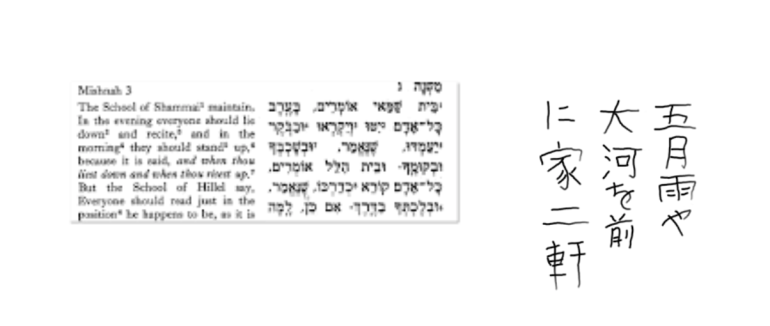
Perhaps the setting lulled you into thinking that you know the people involved. How easy it is to assume that everyone at a twelve-step meeting has only one salient characteristic: their addiction. And yet…while everyone at the meeting has come there for support in coping with the effects of addiction, each one has his or her or their own path that’s led to this point. Each individual speaker is much more than the story of addiction that brought them to this moment. As beautifully expressed by Nigerian author Chimamanda Ngozi Adichie, in her TED Talk, The Danger of a Single Story, we are all made up of multiple storylines and multiple threads.

Screen Shot 2020-02-23 at 9.22.36 PM

It is tempting — nearly inevitable — to assume that we know somebody because we know one or two or even five things about them. Yet every single one of us contains multiple experiences, multiple cultures, multiple points of view.

What does Judaism do with this? How does our sacred wisdom prepare us to take this in, to navigate this space of riotous color and shimmering individuality? 

Screen Shot 2020-02-23 at 5.57.13 PM

Consider a page of Talmud. Laid out like a puzzle, or a paper with every inch of margin scrawled with notes and responses and questions, the Talmud is replete with conflicting ideas, interpretations, and viewpoints playing out on the page. Jewish learning is a boisterous conversation across time and space and involving multiple people, sources, and ideas. 

Like a page of Talmud, each of us is a flavorful combination of many different ideas, themes, characteristics, and experiences.

The multiplicity of identity has been playing in my mind quite a bit these past few days, as the news of basketball great Kobe Bryant’s death in a helicopter crash spread. This sudden, tragic loss of a young man is complicated by the fact that in 2003, Bryant was accused of raping a nineteen-year-old woman in a Colorado hotel. The charges were dropped when the woman declined to testify in court. She later brought a civil suit, which was settled out of court. Eventually Bryant acknowledged that he regarded their encounter as consensual sex while his accuser did not. He apologized.

Following this awful incident, Bryant went on to live his life in ways that suggest he learned and grew and changed. He became an outspoken supporter of women’s athletics. He eventually came to use his celebrity to support political causes that were meaningful to him. He became a father to four children, one of whom, sadly, died with him in the crash. 

I do not condone rape or sexual assault, but I do absolutely condone teshuvah. My feelings are complicated as the story of Bryant’s life and death plays out in the media against the backdrop of the pluralism learning my cohort has recently engaged in. If our lives all comprise multiple threads, what if one of those threads is truly awful? Is an otherwise good life ruined by one horrific act? Can an array of generous, wholesome choices, including a genuine apology, atone for one crude and violent one? What is the sum of a life?

We learned in our pluralism seminar that one definition of idolatry is the isolation and worship of a single aspect of the Divine, to the exclusion of other characteristics. Our teacher, Rabbi Sharon Cohen Anisfeld, extended the definition, writing, “It is similarly idolatrous to take one aspect of a human being — created in the divine image — and mistake it for the whole.” We are — each and every one of us — created in Gd’s complicated image, our very ordinariness full of mystery.

One way to understand Gd’s many facets is as multiple pathways to access the Divine. The Sfat Emet’s read on Sh’mot 20:15, in Rabbi Arthur Green’s translation, says: “All the people saw the voices. The voice was that which said, ‘I am YHWH your Gd.’ Each one of Israel saw the root of his or her [or their] own life force.” In this interpretation we see the interplay between singular and plural (voice and voices), the ways in which Gd is One and yet can be understood in infinite ways. Individual senses are blurred, such that sound is both seen and heard. Yet the voice that comes to each person is exactly the right voice for him or her or them, a voice tuned exactly to their frequency. 

Think also of the role of the new year in the liturgy and the calendar cycle: we celebrate the new year in four different ways and at four different times, focusing this time on redemption and this time on nature, this time on getting our economic accounts in order and this time in accounting for our souls and deeds. But day by day, we call for blessing on the year as part of the tefillah, asking Gd to make this year the best among the best. Each day is both a beginning and a continuation, each year a whole and a part.

One beauty of our tradition is that there both is and is not a single story of Gd. When addicts turn to a higher power, as in the vignette that opened this post, they are seeking the same thing — an anchor against the disorienting forces of addiction — but they each seek the aspect of it that will keep them, each in the fullness of their own individuality, centered. Just as the addicts resemble one another in one way but are thoroughly unique in other ways, so it is with Gd. The mechanic’s Gd and the caregiver’s Gd, the proud father’s Gd and the bereaved daughter’s Gd are One and not the same.
Daf Yomi and Dr. King

I am not doing Daf Yomi (because the space-time continuum) but I occasionally glance at it just the same. Today’s had some resonance for me on this Martin Luther King holiday, particularly about the side of Dr. King that faced up to racism and non-violence in such profound ways.
 
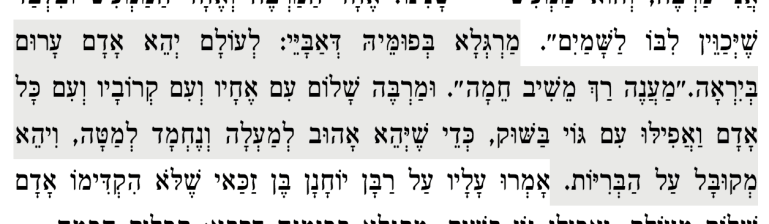
“Abbaye often said: One should always be straightforward and respectful. ‘Answer softly to wrath.’ (Proverbs 15:1) Increase peacefulness with family, with those around you, and with those you encounter, even the stranger in the marketplace, in order to be beloved above, kind below, and worthy of acceptance by all creatures.”
 
At the workshop I attended this morning alongside Child the Elder, a young Black woman talked with us in our small group about how hard non-violence is, about how tempting it is to want revenge, the more she learns about her history. Her courage and vulnerability are in strong contrast to the demonstrators — some of them explicitly associated with white supremacy organization — who turned up in Richmond, Virginia today to proclaim their attachment to weapons of violence. I wonder if those demonstrators think of themselves as increasing peacefulness.
 
We live in serious times. Increasing peacefulness seems like a good start.

A Progress Report in Two Parts

Sometimes the moments line up just right. For more than a year I have been coming to morning tefillah (prayer) at Hebrew College, since long before I started school. It was part of my grounding practice while I was in between, and it was instrumental in helping me to make my decision. In the course of that practice, especially at the beginning, I felt lost more often than not, sometimes extravagantly so. 

There was one day that was so unsettling that I wrote about it here. On that day, there were no guideposts in prayer, just an open space and a lot of people doing their own thing with what looked to me like unattainable competence. It was so unnerving I considered leaving, but was afraid people would notice me leaving and it might affect my chances of being admitted to the program.

Fast forward about a year.

This morning, just days from the end of my first semester as a rabbinical student, I came in for tefillah a few minutes late to find there were three other people there. All faculty. All engaged in their own personal, mostly silent prayer. There was a little mumbling, a little humming, an occasional snatch of recognizable text, a lot of page flipping.

I walked in, opened my siddur, and began to pray.

***

This afternoon I went to see one of my professors for a quick question. So I thought. Nearly two hours later, I left his office, having moved from the so-called quick question to a deeper conversation to impromptu study of a famous text about Rabbi Akiva. Akiva is one of my favorites, for two reasons: he happens to share a name with my beloved elder son. And he started studying as an adult.

The text I studied with my professor depicts a moment where Akiva contemplates the mouth of a well and muses to his companions: How did this stone get worn away? They tell him, The water falls on it every day. Haven’t you read that water can erode stone?

Akiva extrapolates a judgment for himself: if something soft can sculpt something hard, how much more can something hard, like words of Torah, shape something soft, like my heart?

And presently he began to study Torah.

Teach us how to see

Our parsha this week, Vayetze, continues the story of Jacob. When we last left our hero, he was skipping town in order to escape the wrath of his brother Esau, on account of Jacob’s having stolen Esau’s blessing from Isaac, their father. This was just the latest bit of trickery between the two brothers, and the trickery will continue into this parsha, with Jacob getting some karmic payback from his Uncle Laban, who makes him work for seven years to “earn” his beloved Rachel and then pulls a switcheroo and sends Rachel’s sister Leah on the wedding night. But I get ahead of myself.

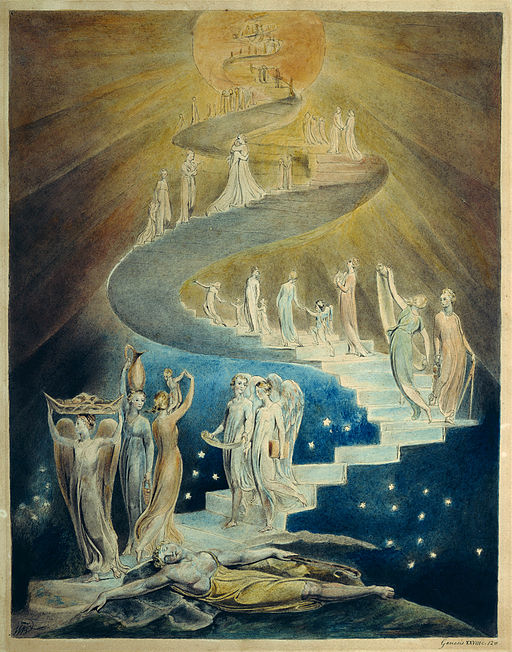
One of the opening images of Vayetze never fails to take my breath away. Jacob is running from Beersheva toward Haran and he stops for the night. He makes a bed of stone to sleep on and while he sleeps, he dreams of a ladder with angels going up and down. In the dream, G-d promises Jacob numerous children and the land where he lies. When Jacob wakes up he is transformed and says these beautiful words:

יש יי במקום הזה ואנוכי לא ידעתי

G-d was in this place and I didn’t know it.

This parsha glimmers with allusions to vision and perception, starting with the dream-vision of angels going up and down the original “stairway to heaven.” There are things that are clear in a moment (like Jacob’s interest in Rachel) and things that reveal themselves over time (like the ways in which Laban and Jacob try to get the better of each other and Rachel’s struggle with infertility). And Leah, who is described as having weak eyes is actually quite perceptive about her place in Jacob’s esteem. Even with her weak eyes, she sees quite clearly that he will never love her.

All these variations on the themes of vision and perception have got me thinking about what it means to see clearly. We live our lives, many of us, looking at most a few feet in front of ourselves. Our lives are mediated by screens of one kind and another, and much of what we think we see on those screens is curated, manufactured, or outright fabricated. Searching for the truth seems to get more and more difficult with each passing day. And even when we manage to break free of our screens — at dinner time, on Shabbat, or what have you — sometimes it’s our minds and hearts that get in the way. We focus on weather or logistics or petty disagreements and don’t find it easy to level up and see what is most important.

When I was in high school, literally in the last century, I committed to memory a line from the book, “The Little Prince,” a line that felt profound to my teenage self: On ne voit bien qu’avec le coeur. L’essentiel est invisible pour les yeux. “We can only see clearly with the heart. The essential is invisible to the eyes.” As I studied and pondered the parsha this week in preparation, this beautiful little quote came back to me and with the experience of the intervening years, it felt perhaps even more profound than I’d realized. How often our perceptions change over time, as our hearts begin to see more clearly what is important! The more time and genuine presence we offer, the more clearly we begin to see. The uncooperative toddler begins to feel more like someone who is struggling to learn something new. We stop seeing our spouse as a collection of annoying habits topped off with a receding hairline and remember the kindness that made us fall in love in the first place. In these moments, our eyes get out of the way and our hearts do the work.

Now let’s go back a minute to those words Jacob utters when he wakes up from his dream. 

יש יי במקום הזה ואנוכי לא ידעתי

The phrase לא ידעתי means ‘I didn’t know it’ and within the word ידעתי is the word דעת. if you look up דעת in a dictionary it will say ‘knowledge or wisdom, but Rabbi Art Green taught me that it’s also used in Hassidic thought to refer to the mind of G-d. When Jacob awakens from his astounding dream, it is as if he has glimpsed the mind of G-d, or even more remarkable, he seems to have realized that his own awareness has something in common with the mind of G-d, that when he sees something amazing it is like peering into the mind of G-d.

In fact, in one of the blessings following the Sh’ma, G-d is referred to as the Rock of Jacob. I think that when Jacob sleeps on that rock, he is actually resting his mind with G-d’s, and just like the method of learning by osmosis by placing a book under your pillow, Jacob awakens with a clarity of vision that comes from having glimpsed the mind of the Holy One. 

We often go through life not realizing the holiness of what surrounds us. Whether we’re absorbed in work, or preoccupied with personal difficulties, or staring at a screen, it’s easy to go through the whole day — sometimes several days — without noticing that the sun rose and the world is pretty amazing. My wish for you this Shabbat is that you will go out from this service with a kavannah, an intention, of seeking and seeing more clearly all of the beauty and purpose that surrounds you. Perhaps if your eyes and your heart are truly open, you will even catch a glimpse of דעת, the mind of G-d. Shabbat shalom!

A Snarky Little Musing on Rebekah

If Rebekah lived today she’d probably have pink hair to go with the nose-ring that Eliezar gives her to mark her as Isaac’s betrothed. She comes from a family that is, in colloquial terms, effed up. Her dad Betuel is a specter who barely does anything. But hey, at least he gets a name, which is more than can be said for her mother. Her brother Laban is a greedy sneak, a petty crook who looks for every opportunity to profit off her, as he will later do to his own daughters. 

When Abraham’s servant Eliezar gives Rebekah a sample case of the family jewels, she sees opportunity. Maybe she has a bit of the family greed herself. Anyway, she guesses there’s more where that came from and damned if she’s gonna share it with her slimy brother. She agrees to go off with Eliezar to join Abraham’s household. How bad can it be, with all that swag?

Little does she know her new fiancé is long in the tooth and full of troubles and griefs. Having been threatened at knifepoint by his own dear old dad, and now recently bereaved of his mother, Isaac is hollowed out. 

Nonetheless, Rebekah falls for him, falls right off her camel. Maybe she was surprised at what she’d gotten herself into. The dudes that wrote down the stories want you to think she fell in love at first sight with this pathetic old creature but that’s such a dude thing, isn’t it? Maybe she was just ass-sore from riding a camel.

Anyway, she’s stuck with him now, and he’s probably better than her original family. She and Isaac have twins, Jacob and Esau, and even before they’re born, they’re fighting. Esau is born first and is Daddy’s little man, but Rebekah always favors Jacob. When it comes time for Isaac to bless his favorite kid before kicking the bucket, Rebekah manages to disguise Jacob as Esau so he can snatch the blessing right out from his big brother’s hairy nose.

Daughter of a specter, sister of one wily dude, she holds her own and makes way for her baby to get what he needs.

Mishna Berachot 1-5 in Haiku

Last week we had an exam in Mishna class and the essay question gave us the opportunity to delineate the differences in approach between Sh’ma and Amidah, as discussed in the Mishna. For reasons I can’t quite fathom, I decided to write it in haiku. This post is probably not for everyone but for those few people who traverse the intersection of Mishna and Japanese poetry, this is your moment.

Click here for the original mishnayot.

Sh’ma and Amidah
How to do community?
Mishnayot differ.

You might also ask
Is the structure fixed or loose?
Depends what you pray.

When to say the Sh’ma?
If you go out late at night
Say it before dawn.

When the day arrives
Say it now, pray before nine
If your dad’s a king

Don’t take foolish risks
In your home or on your way
Just to make a point.

While the frame is loose
Structure holds the thing in place.
Do your chatimot!

When we pray the Sh’ma
Boundaries are fluid here.
Hi   [I’m scared]   Oh, hi?

What if I mess up?
Or I cannot hear myself?
In Sh’ma that’s OK.

When you get married
Maybe skip Sh’ma, just this once
Maybe, maybe not.

Sometimes people choose
Things that don’t check every box
Sh’ma is flexible.

When you’re on a wall
Or atop a terebinth
Praying Sh’ma’s OK.

Unlike with the Sh’ma
When you pray the Amidah —
The stakes are higher.

Saying Amidah
We hold the community.
Leadership matters.

You should take your time
Getting in the proper mood
Even one hour

Fewer options here
Time of prayer is fairly clear
(Maybe not Musaf)

Rabbi Akiva:
Every day say Amidah
Do the best you can.

Improvisation?
Keep community in mind
Preserve the remnants

Birkat Kohanim
If you are the only priest
Do not lose your place

In community
We hold one another up
Even when we can’t.

The Way You Make Them Feel

[This is a sermon I wrote for my friend to deliver, with attribution, at her community’s pop-up High Holiday services.]

They say that people may forget the words you say or the way you look, but they will never forget the way you make them feel. Sometimes it feels like people pay less and less regard to this basic concept. We’ve all had experiences that drive this point home: someone says or does something thoughtless and — even though you know they didn’t mean it — you still feel awful. Or maybe they did mean it, and you feel even worse. It seems to be an ever-present and self-perpetuating phenomenon. The more unkind people are, the more it emboldens people to be unkind, until the harshness spirals out of control. Maybe it feels these days like it’s getting worse.

And yet there is a parable in our tradition that suggests that, as hard as people may seem these days, 21st century America did not invent the coarseness that characterizes our world right now.

In ancient times there were two people with similar names: Kamtza and Bar Kamtza. Think GoldSTINE and GoldSTEEN. A subtle distinction, but it turns out to be a difference that makes a difference. The story goes that there was a wealthy man who was throwing a big party. He wanted to invite Kamtza but his servant made a mistake and invited Bar Kamtza instead. It turns out, though, that the host detested Bar Kamtza and was determined that that guy not come to his party. 

On the day of the party, when Bar Kamtza arrived, the host was so enraged to see him that he asked him to leave. Bar Kamtza wanted only to save face, so he asked if he could stay, if he just didn’t eat or drink anything. The host said no. Bar Kamtza offered to pay for everything he might eat or drink at the party. The host still refused. Finally Bar Kamtza offered to pay for the entire party, and still the host would not allow him to stay. He had him kicked out.

Meanwhile, all the dignitaries, all the rabbis, all the fancypants people in the town were there, and nobody said a word. They allowed the host to embarrass Bar Kamtza and nobody spoke up for him. 

Jewish tradition holds that there were two sins in this interaction: the pointless hatred that caused the host to regard Bar Kamtza as his enemy and not allow him into his home, and the silence of the bystanders as they witnessed Bar Kamtza’s humiliation. 

You probably need no reminder of the ways in which this story resonates today — funny names aside. We are all too familiar with the stories: whether it’s someone in high office making fun of a person with disabilities, or children teasing the new kid or the short kid or the kid whose clothes are ragged, or the person in line at the grocery store making racist assumptions about the cashier, or the bullies who threaten a gay couple walking home from the movies. This short list barely scratches the surface of all the ways we have learned to be unkind.

Sometimes it can feel like life is one big comments section. 

Now let’s look at another story. Perhaps you’ve heard this one as well: it concerns a religious order that has fallen on hard times. There were few practitioners left and the leader was concerned that the order was dying out entirely. The leader went to speak with a Rabbi in a nearby town. They talked about their struggling communities, about their faith, about the mysteries of life and death. It was a wonderful conversation! Then just as he was leaving, the leader of the struggling community mentioned to the Rabbi his concern about the future of his group. The Rabbi sighed with him and said something cryptic: “One of you is the Messiah.” 

The leader went back to his small group, just five people left in his community. He mentioned his conversation with the Rabbi, and the strange thing that he’d said. The other five mulled it over… “One of us is the Messiah? Couldn’t be. Unless…” “Must be our leader. He’s the only one who seems qualified.” “Maybe it’s Sister Angela. She is old and grouchy but, you know, she’s often right. Sometimes very right.” “Maybe it’s Brother Thomas. He has such a gentle way about him, he could very well be the Messiah.” “Hmm, I wonder if it’s me?” 

Subtly at first, then noticeably, the culture began to change in this dying order. People began to treat one another as if they might be the Messiah. They became more patient, more likely to listen carefully; who wouldn’t want to listen to the Messiah? They helped one another more freely; after all, each of them thought, “if I’m the Messiah, I should really be more helpful.”

Gradually people from outside the order began to notice how kind and welcoming that community was, and they started to take an interest in the learning taking place there, and eventually participating more and more. Suddenly the dying order was full of life! The Rabbi’s gift was just what they needed to revive. 

There is a poem by Danny Siegel that is perfect for this theme, and perfect for us to keep in mind not just at the High Holidays but year round.

If you always assume the person sitting next to you
is the Messiah
waiting for some simple human kindness – 

You will soon come to weigh your words
and watch your hands.

And if the Messiah chooses
Not to reveal himself in your time –
It will not matter.”

Let’s all hold close to that thought. One of us is the Messiah. Or maybe, just maybe… all of us are. 

Shana tova!

Let All that have Breath… Work for Change

[This is the sermon I delivered on Yom Kippur 5780 at Shir Hadash Reconstructionist Havurah in Newton, Massachusetts.]

Shana tova! How’s everybody holding up?

So here we are, midday on Yom Kippur. Those among us who observe by fasting are probably starting to feel it. Let’s take a few breaths together to get centered.

Breathing is underrated. We do it all the time: sometimes with intention, sometimes absent-mindedly, sometimes frantically, sometimes with awe and wonder. It is easy to take breathing for granted…until you have a terrible cold, or are singing a really long note, or are in the company of a skunk. Yet breathing, when you pay attention to it, can be soul-filling. 

The Hebrew language makes a pretty strong connection between breath נשימה [neshima] and soul נשמה [neshama]. Technically you might say that breath is just the air going in and out of our lungs, but clearly the Hebrew language wants us to think more expansively about it. Breath is not merely anatomical but spiritual. When we breathe, we are somehow gaining access to our very souls.

In fact, the two words are sometimes translated as though they are interchangeable. Psalm 150, for example, describes praising G-d with different instruments: shofar, harp, tambourine, lute, cymbals … and finally, ecstatically: 

כל הנשמה תהלל יה הללו-יה

Some translators interpret that line as: “Let all that breathes praise G-d; hallelujah!” while other translators interpret it as: “Let every soul praise G-d; hallelujah!”

Rabbi Sharon Cohen Anisfeld, the President of Hebrew College, teaches, “the sound that comes through the hollow bent horn of a ram is the sound of human breath, amplified, so we might hear it.” We spoke last week about the ways in which the sound of the shofar wakes us up. In our short chevruta study, we directed our thoughts to the ways in which the shofar calls us to remember what’s most important, and in these past ten days of teshuva, we have, each in our own way, been coming to terms with the ways in which we may have fallen short of our highest aspirations, taking stock of the relationships and concerns in our lives which merit deeper attention. 

So last week the shofar woke us up to the need in the world… but it was kind of a cliffhanger. This week, those who observe this way up the ante with a 25-hour fast. In this time of intense soul-searching, we deprive ourselves of the pleasures of the body so that we can really focus on the needs and longings the shofar blast awakened us to. But I’m sure I don’t need to tell you: it is easy to get so focused on our individual discomfort that we lose track of the purpose of the fast.

Today’s haftarah reminds us of this. Isaiah has a few things to say about the prospect of an empty fast. In verse 3, the people complained to G-d: “Why, when we fasted, didn’t You notice? When we starved our bodies, did You pay no heed?” 

Finishing the verse and going on, Isaiah posits G-d’s answer: “Because on your fast day, you see to your business, and oppress all your laborers! Because you fast in strife and contention, and you strike with a wicked fist! Your fasting today is not such as to make your voice heard on high. Is this the fast I desire, a day for people to starve their bodies? Is it bowing the head like a bulrush and lying in sackcloth and ashes? Do you call that a fast, a day to be right with G-d? No, this is the fast I desire: to unlock the fetters of wickedness, and untie the cords of the yoke; to let the oppressed go free; to break off every yoke. It is to share your bread with the hungry, and to take the wretched poor into your home; when you see the naked, to clothe him, and not to ignore your own kin.”

If you’re fasting to get G-d’s attention, you’re doing it wrong. G-d asks us to fast in order to get our attention.

Now. One of my touchstones in this world is listening to my children breathe. When they were little enough that I could hold them, the sound of their breathing became like the sweetest music to me. Even now that they are older (and probably mortified right about now!), I find contentment and spiritual solace in hearing their breaths, in and out, in and out. When I go in to wake them up in the morning, I sometimes take a moment of quiet in their room before I do the deed, so I can listen to them breathe. It fills my soul.

A couple of weeks ago, along with several friends from Hebrew College, I participated in the Massachusetts Climate Strike. I went for lots of reasons: I was motivated by a feeling of frustration at the way the pace of scandal in the current administration leaves us unable to focus on the most consequential matters because we are too busy being shocked about the latest outrageous tweet. I was motivated by a desire to stand side by side with the young leaders and activists I share my days with. Most of all, though, I was motivated, perhaps selfishly, by the hope that my children would have air to breathe, G-d willing, long into the future, and that they could one day know the pleasure of hearing their own children breathe.

The more I read and learn about it, the more urgent I realize the climate change crisis is. According to the UN report from March of this year (or last year according to the Jewish reckoning) scientists believe that we have just eleven years before the damage wrought by climate change is irreversible. 

We have seen some climate-related devastation already in the form of melting polar ice, species extinctions, and the increasing frequency of storms whose strength would once have qualified them as once-in-a-century events. Just the damage caused by the last few hurricane seasons should be enough to get our attention. In the Bahamas alone, over 70,000 people were left homeless after Hurricane Dorian. Two years ago, the death toll from Hurricane Maria’s devastation was nearly 3,000 in Puerto Rico. And nearly fifteen years after Hurricane Katrina, parts of New Orleans are still struggling to recover. 

As with most things, the effects are worst on those who have the least, but you don’t have to be impoverished or live in a coastal area to be affected. Climate-related disasters have wide-ranging intertwined effects on wildlife, beach erosion, tourism, epidemics and other issues around the spread of disease, economic stability, migratory patterns and more. Everything that happens in an environmental or weather event touches off other consequences in many arenas. 

Getting interested in the climate crisis is about much more than hugging the pretty trees and protecting the wide-open spaces we love. This truly is — or should be — a matter of global concern, and of global action.

So what can you and I do? We have little influence, little economic power. Even my modest lifestyle, my commitment to reusing and recycling, my efforts to emphasize real food made with recognizable ingredients — all this still feels like whistling in the wind compared to the enormity of the problem. Yet when I marched with 40 folks from Hebrew College alongside an estimated 7,000 people — that’s a lot of whistling! And the global numbers are quite staggering. The folks who do this kind of counting estimated that at least one million people participated worldwide in the climate strike in September. Imagine the noise that a million people whistling can make! It might even rival the shofar.

Clearly there is much work to be done, and if we all work together we can make a difference. If I decide no longer to use single-use plastic such as plastic cutlery & cups that’s one thing. If we all do, that’s something more. If we model this one small change and talk it up in our workplaces and with our families and friends, we can really begin to make a difference. And that is just from one small change. One of my fellow students pledged publicly to give up driving to and from school one day a week in favor of public transportation, and I am working on the carpool logistics to be able to make the same pledge. Whether these small changes speak to you, or something else does, I urge you to consider what you can do to increase your positive impact on the world.

As we read in the maftir today,

רְאֵ֨ה נָתַ֤תִּי לְפָנֶ֙יךָ֙ הַיּ֔וֹם אֶת־הַֽחַיִּ֖ים וְאֶת־הַטּ֑וֹב וְאֶת־הַמָּ֖וֶת וְאֶת־הָרָֽע

“See, I set before you this day life & good, and death & adversity. For I command you today, to love Adonai your God, to walk in G-d’s ways, and to keep G-d’s commandments, laws, and rules, so that you may thrive and increase, and that Adonai, your G-d, may bless you in the land that you are about to enter and possess.”

These words are as relevant today as they were originally. The land is crying out for us to make different choices, to contemplate the gift of Nature that G-d gave into our care in B’reishit, and to exercise our stewardship in a more responsible and thoughtful way.

There is a line in our Yom Kippur liturgy that we chant several times, 

אנו נחלתך ואתה גורלנו

We are Your inheritance and You are our fate. 

I’ve been pondering what it means to say that we are G-d’s inheritance. It’s puzzling — G-d doesn’t have possessions in the conventional sense. And from whom would G-d have inherited anything anyway? Who could possibly be further up the food chain?

One day recently when I was out walking in the woods and thinking about this beautiful planet whose creation we had nothing to do with, but whose gradual destruction we might be witnessing, I began to see it in a different way. It’s not that we are an inheritance in the sense that an old family wristwatch or a stash of love letters between long-dead ancestors might be. Rather, we are an inheritance in the sense of what’s left behind. We are what’s left, the remnants of the people before us, and the people before them, and the people before them. G-d is counting on us. Let’s step up, so that the “inheritances” ahead of us — our children, and theirs, and theirs after that — will have air to breathe, water to drink, space to live, and please G-d, a world at peace.  

G’mar chatima tova! 


Atonement | Alonement | Alignment

T’shuvah: Extended Definitions

I have been thinking lately about how t’shuvah can leave people feeling discouraged and defeated, and about the ways in which people find Yom Kippur and the process of t’shuvah heavy. I don’t think that’s what G-d wants for us. Our tradition teaches us always to look for reasons to kindle hope, so how can we frame t’shuvah in a way that makes space for that while still doing the serious work t’shuvah requires? This is an attempt to address that question.

Atonement: Examining mistakes from the past year and seeking to make them right. Whom have I hurt, whether intentionally or unintentionally? Where have I been dishonest? When did I say the unkind word? Where have I cut corners in my work in ways that placed more burden on others? When did I not stop myself from yielding to my lesser impulses? Who was affected by my actions in ways I regret now? Who might have been affected by my actions in ways I don’t even know about?

Alonement: Taking some time alone to search deep within. Where have I been dishonest with myself? Where have I cut corners in my work, that only I would know about? Where have I judged myself too harshly? Where have I judged myself too gently? Were there decisions I made that were expedient but not wise? When did I squash my own needs in order to make things right for everyone else? What did it cost? When did I prioritize my own needs over everyone else’s? What did it cost?

Alignment: Expressing gratitude for the people and events that have helped me grow in the past year. We spend a lot of time and energy in these Ten Days of T’shuvah looking at ourselves and our actions through a negative lens. This is necessary work that must be taken seriously. What happens if we also look through the other side? Who helped me see my actions in a new light? What events forced me to level up and be more thoughtful of others? Whom have I been watching as a model for how to do something I don’t yet do well? Who has offered me a kind word when I needed it? In what ways have I come closer to my center this year, and who has helped me get there?

Elul: Writing my own S’lichot

Rabbi Jordan Braunig’s prompt last night (I’m on the “better late than never” plan!) was to write our own S’lichot.

Forgive me…for being impatient with people who matter to me.
Forgive me…for being impatient with people who matter less to me.
Forgive me…for thinking I’m smarter than I am.
Forgive me…for thinking I’m not as smart as I am.
Forgive me…for doubting myself.
Forgive me…for doubting You.
Forgive me…for trying to do too many things at once.
Forgive me…for not trying hard enough to do the needful.
Forgive me…for hubris.
Forgive me…for fear.
Forgive me…for weaponizing insecurity.
Forgive me…for denigrating humility.
Forgive me…for wasting precious time.